Most HVAC owners think about missed calls as a customer service problem. A homeowner calls, no one answers, they call the next company.
That is accurate but incomplete. The better framing is economic. Every inbound call has a calculable dollar value. When that call goes unanswered, or is answered but not booked, that value transfers to a competitor. It does not disappear.
Understanding your revenue per inbound call gives you a number that makes staffing decisions, after-hours coverage decisions, and CSR investment decisions much easier to evaluate.
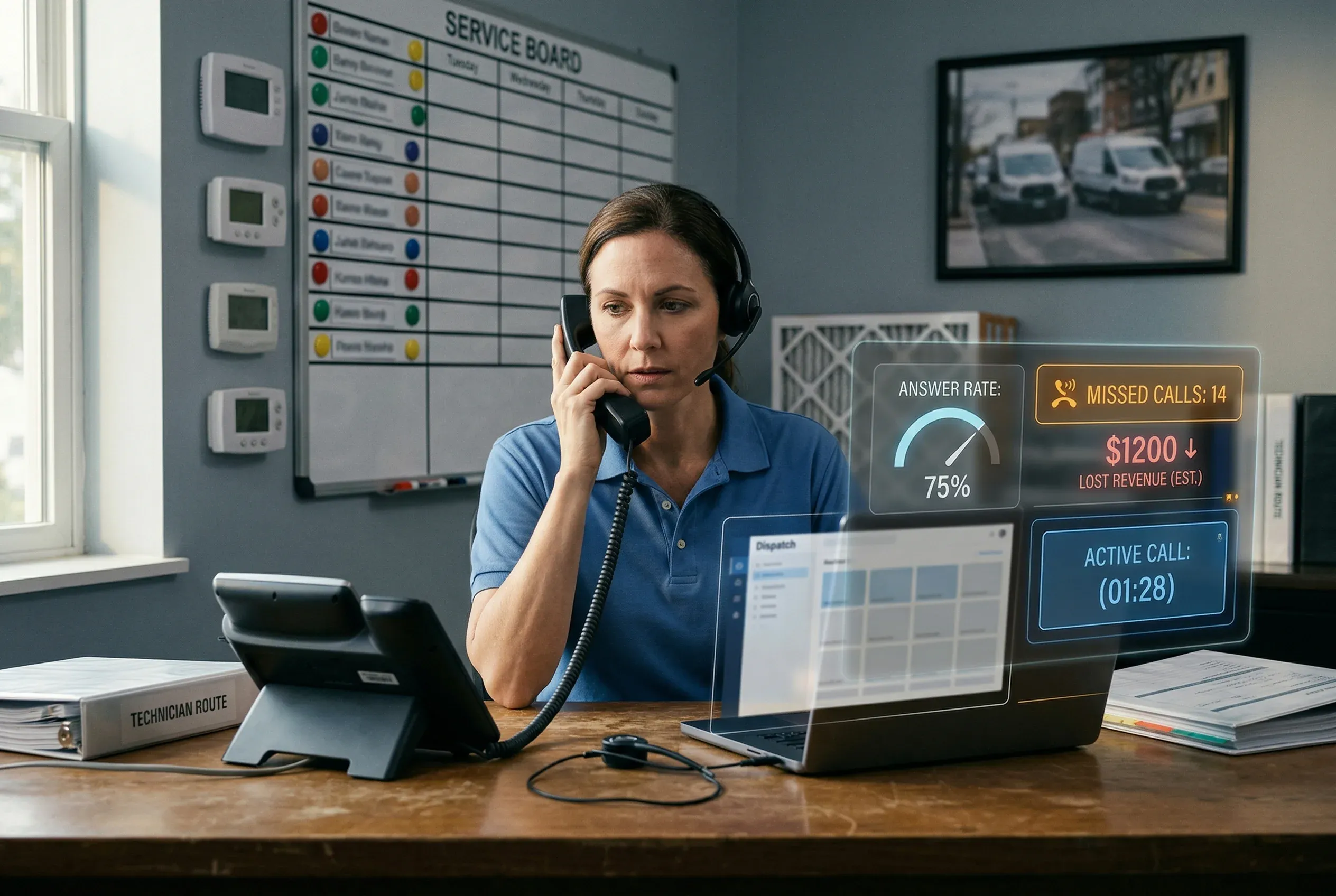
[Image placeholder: HVAC phone system dashboard showing call volume, answer rate, missed calls, and booking rate for a representative day]
Why the Phone Is Still the HVAC Revenue Engine
Despite the growth of online booking and text-based inquiry, voice calls remain the dominant revenue channel for residential HVAC companies.
When a homeowner’s AC fails in July, they are not submitting a form and waiting 24 hours for a callback. They pick up the phone. When a furnace stops in January at 11pm, they search for a company with emergency service and call the first number that looks right.
Research in home service categories puts roughly 90% of HVAC revenue flowing through inbound phone calls. This is not changing fast. The urgency inherent in HVAC service, especially emergency calls, makes the phone the natural channel for high-intent customers.
That concentration of revenue through a single channel creates significant risk when the channel is poorly managed. A company that misses 20% of its inbound calls is not losing 20% of potential inquiries. It is losing 20% of potential revenue at the moment that revenue is most likely to convert.
The Revenue Per Call Calculation
Your revenue per inbound call is the product of three numbers: average ticket, booking rate, and the assumption that every answered call is a revenue opportunity.
Work through a concrete example. An HVAC company receiving 150 inbound calls per month with a 60% answer rate, a 45% booking rate on answered calls, and a $380 average ticket:
150 calls times 60% answer rate equals 90 answered calls. 90 answered calls times 45% booking rate equals 40.5 booked jobs. 40.5 booked jobs times $380 average ticket equals $15,390 in monthly revenue from inbound calls.
Now calculate revenue per inbound call: $15,390 divided by 150 total calls equals $102.60 per inbound call received.
That is what each call is worth to this business on average, including the ones that never get answered or never get booked. The value of each individual answered-and-booked call is significantly higher.
The revenue per answered and booked call: $15,390 divided by 40.5 booked jobs equals $380, which is just the average ticket. But the revenue value of each answered call (accounting for the booking rate) is $15,390 divided by 90 answered calls equals $171.
At $102.60 per inbound call received, a company missing 30 calls per month is losing $3,078 per month in potential revenue. Over a year, that is $36,936.
This is the calculation the Phone Revenue Calculator runs for your specific numbers. The goal is to make the cost of an unanswered call visible as a dollar figure rather than an abstract concern.
How Answer Rate and Booking Rate Multiply Each Other
These two metrics compound. A weakness in either one amplifies the cost of a weakness in the other.
Consider two scenarios:
Scenario A: Answer rate of 55%, booking rate of 40%. On 150 calls, 82.5 answered, 33 booked.
Scenario B: Answer rate of 80%, booking rate of 55%. On 150 calls, 120 answered, 66 booked.
Same call volume. Scenario B produces exactly double the booked jobs from the same inbound volume, purely from improvements in answer rate and booking rate. That is not a marketing improvement. That is a phone operations improvement.
The industry average booking rate is 42%, according to ServiceTitan data across trade businesses. That means the average HVAC company is converting fewer than half of answered calls into appointments. A company that improves its booking rate from 42% to 52%, without any change in call volume or marketing spend, produces meaningfully more jobs from the same traffic.
The CSR performance article covers the booking rate side of this equation in detail. This piece focuses on the economic frame: what each percentage point of improvement in either metric is worth in dollar terms.
What One More Booked Call Per Day Is Worth
This is the simplest version of the revenue-per-call math, and it is often the most clarifying.
If your operation is running 20 working days per month and you book one additional call per day through better answer rate, faster callbacks, or improved CSR performance, you add 20 booked jobs per month.
At $350 average ticket: $7,000 per month or $84,000 per year. At $450 average ticket: $9,000 per month or $108,000 per year. At $600 average ticket: $12,000 per month or $144,000 per year.
One additional booked call per day. Not 10 more marketing leads. Not a new truck. Not another technician.
That number changes the math on investing in after-hours coverage, better CSR training, or a faster callback system. If the cost of those investments is below the revenue they produce, the investment decision is straightforward.
[Image placeholder: Simple revenue impact chart showing the dollar value of 1, 3, and 5 additional booked calls per day at three different average ticket levels]
The After-Hours Call Problem
HVAC emergency calls happen at night, on weekends, and during holidays. Those are the same times most HVAC companies have reduced staffing or no live answer at all.
A company that advertises 24/7 emergency service but routes after-hours calls to voicemail is advertising a service it is not fully delivering. Homeowners who need emergency service and reach voicemail are almost universally calling the next company immediately. They are not leaving a message and waiting until morning.
The revenue value of after-hours coverage is straightforward: if your company receives 15 calls between 6pm and 8am on weekdays and weekends combined, and you currently answer zero of them, what is the revenue impact of answering and booking 50% of those calls?
At an emergency call average ticket of $450 and a 50% booking rate on 15 calls: 7.5 booked emergency calls per day where that coverage exists.
That calculation runs differently depending on your emergency call volume and your geographic market. Run it with your own numbers using the Phone Revenue Calculator.
Paid Traffic Makes Missed Calls More Expensive
There is a compounding cost to missed calls for companies running paid marketing.
When a homeowner clicks your Google Ad, you paid between $20 and $50 for that click. If they call and you do not answer, you paid for a click that produced nothing. The cost per missed call on paid traffic is the CPC, plus the lost revenue from the booking that did not happen.
If your average CPC is $32 and you miss 25% of the calls generated by your paid campaign, you are discarding 25% of your campaign spend with no return before accounting for the booking rate on calls you do answer.
This is why answer rate is not just a CSR training issue. It is a marketing ROI issue. Marketing spend that generates calls only creates value if those calls are answered and handled well.
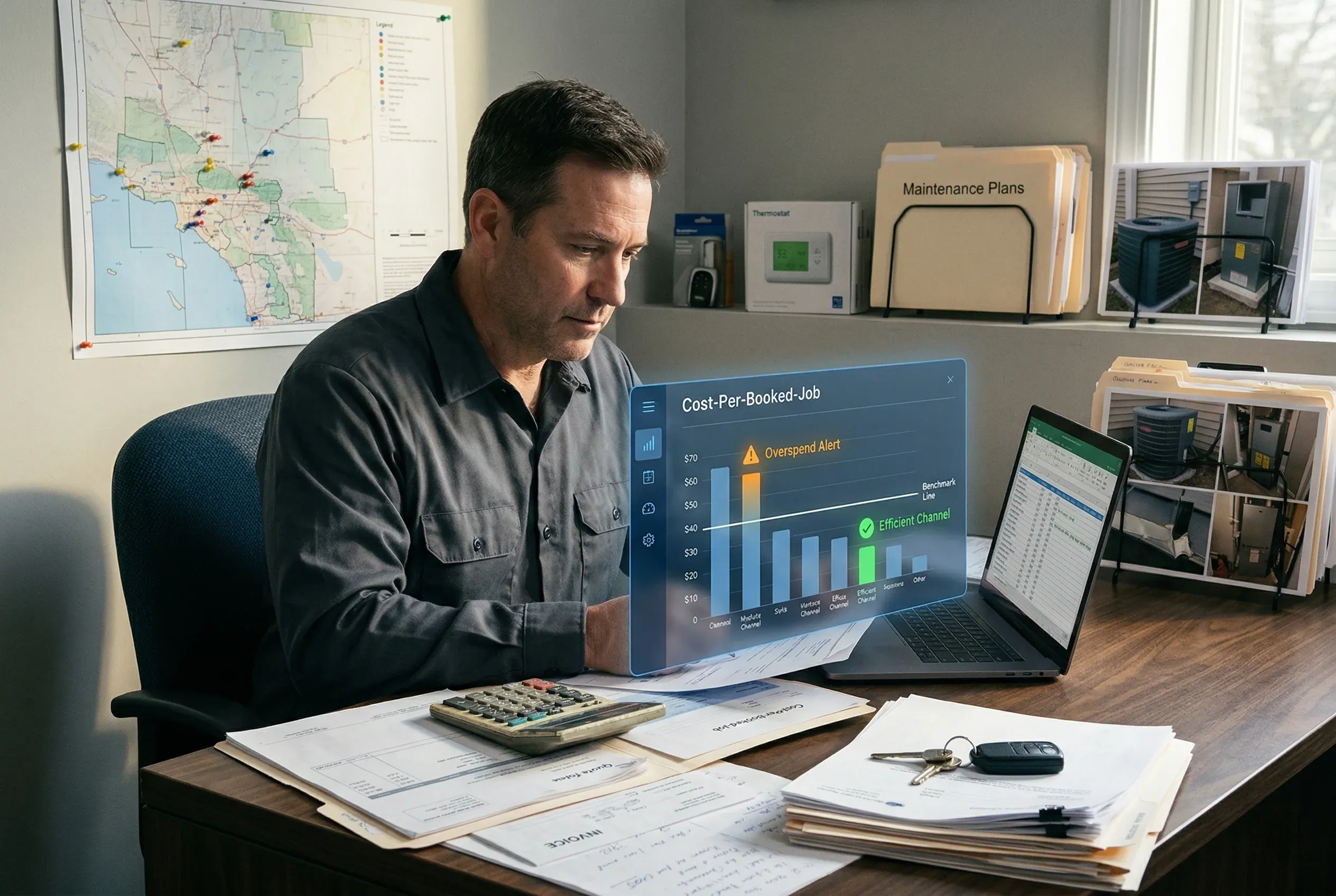
For companies running Google Ads or LSA, the HVAC Cost Per Booked Job by Channel article covers how to connect your marketing channel spend to actual booked-job economics.
What to Do With the Revenue Per Call Number
Once you have calculated your revenue per inbound call, the number gives you a decision framework for specific operational investments.
After-hours coverage: If revenue per inbound call is $95 and you are missing 15 calls per night, that is $1,425 per night in potential revenue not captured. An answering service or AI scheduling tool that costs $500 per month and captures even 30% of those calls produces a clear positive return.
CSR training: If your booking rate is 38% and industry average is 42%, a 4-point improvement on 90 answered calls per month is 3.6 additional booked jobs. At $380 average ticket, that is $1,368 per month in additional revenue from the same call volume. A training investment that produces that result pays for itself quickly.
Faster callback systems: Research shows that lead response within five minutes increases conversion by up to 400% compared to delayed response. For missed calls that leave a message, a callback within 10 minutes versus 45 minutes is the difference between recovering and losing that caller. An automated missed-call text with a booking link recovers a percentage of callers who would otherwise have called a competitor while waiting.
The Marketing Cost Calculator helps you see the full cost-per-booked-job picture across your marketing spend. Revenue per call is the denominator that makes that comparison meaningful.
Frequently Asked Questions
How do I calculate my HVAC revenue per inbound call?
Divide your total monthly revenue from inbound calls by your total monthly inbound call count. For a more diagnostic version, calculate: (total inbound calls x answer rate x booking rate x average ticket) divided by total inbound calls. This gives you revenue per call including the economic cost of missed and unbooked calls.
What is a good HVAC booking rate?
Industry average is approximately 42%, according to ServiceTitan data across trade businesses. A booking rate of 50% to 60% is achievable for companies with strong CSR training and good call coverage. Above 65% on all call types may indicate you are accepting too many low-quality leads or that call volume is low enough that every caller is already highly qualified.
How much does a missed HVAC call actually cost?
At a $380 average ticket and a 45% booking rate, each missed call costs approximately $171 in expected revenue. On a $600 emergency ticket at the same booking rate, a missed call costs $270. Multiply by your monthly missed call count to get your monthly missed revenue figure.
Should I use an answering service for after-hours HVAC calls?
If your after-hours call volume is more than five calls per night and your current answer rate is below 60% during those hours, an answering service or AI scheduling system almost certainly pays for itself. Calculate the expected revenue from the additional calls you would capture and compare it to the service cost.
How does paid advertising interact with answer rate?
Every paid click that generates a call you do not answer is wasted marketing spend. If your campaign CPC is $32 and your after-hours answer rate is 0%, you are paying $32 per call for calls that produce nothing during those hours. Answer rate is a marketing ROI variable, not just a customer service variable.