APRIL 2026 UPDATE: Google’s review policy update on April 16-17, 2026 repriced map pack ranking signals — review volume now matters less than behavioral engagement, recent review velocity, and rating quality. The data and operator profiles below were captured on April 21, 2026; the analysis remains valid, but read Google’s April 2026 Reviews Crackdown alongside this piece to understand what’s now driving rank in this market.
AUDITOR’S OVERVIEW
The Tampa-St. Petersburg-Clearwater AC repair market operates under three conditions no other major U.S. HVAC market combines: year-round humidity that keeps cooling demand active 10+ months per year, salt air corrosion that shortens equipment lifespan by an estimated 20-30% versus inland markets, and a population that swells by approximately 200,000 seasonal residents between November and April. Built on Tenth verified map pack results and public data on seven of the most visible Tampa AC repair operators on April 21, 2026.
THE BOTTOM LINE
Tampa is a replacement-heavy market. The shorter equipment lifespan means the revenue mix for a typical operator tilts toward full-system replacements and new installations more than in any other major Sun Belt market we audit. This reshapes everything — financing prominence on the homepage, warranty language, and the size of the average ticket. If you are running a Tampa operation with messaging optimized for repair-dominant markets, your conversion surface is misaligned with what Tampa buyers are actually shopping for when they reach your site.
This research dossier breaks down who gets found, who gets called, and exactly what the public data shows about the visibility levers winning the Tampa Bay market.
How This Tampa AC Repair Market Research Was Done
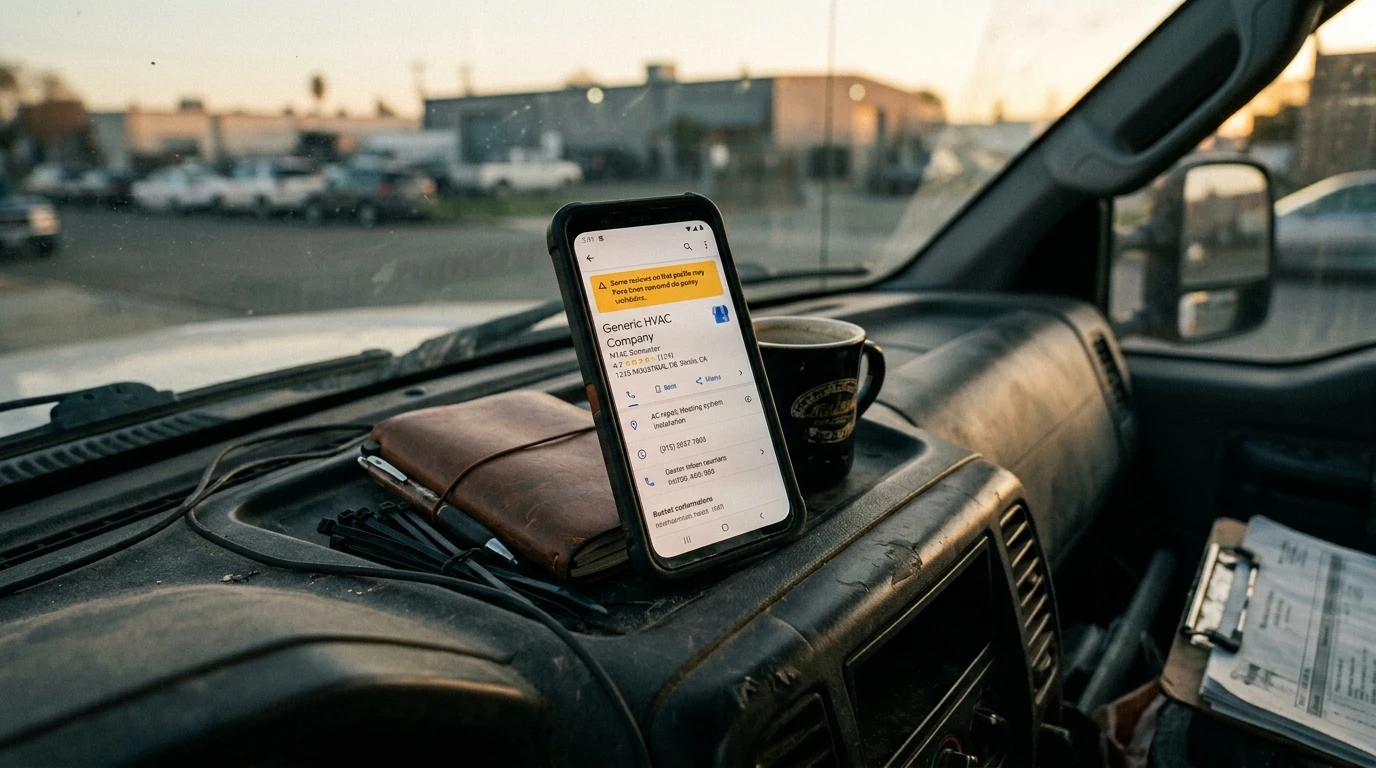
The exact query used was “ac repair tampa fl”, run on Google Maps with a Tampa location context on April 21, 2026. Review counts and ratings were read directly from Google Maps listings — not from aggregators or company websites. Homepage data was captured by visiting each company’s website and recording what was visible in the top half of the page.
Two caveats apply throughout. The Tampa map pack is geographically sensitive across Hillsborough, Pinellas, and Pasco counties — a single point query returns different results from different ZIPs. Review counts and ratings are a snapshot from April 21, 2026, and will have changed by the time you read this.
Tampa AC Repair Operators — Competitive Profile Summary
Before the analysis, here is the competitive set and what each operator looks like from the outside.
Del-Air Heating, Air Conditioning, Plumbing & Electric is one of the largest multi-trade residential operators in Florida, with significant Tampa Bay presence alongside their Orlando and Central Florida footprint. They are the highest-volume brand in this set and operate with standardized pricing and membership across all Florida markets.
Cool Today is a multi-trade operator (HVAC, plumbing, electrical) with deep coverage across the Tampa-Sarasota corridor. Founded in 1963, Cool Today is a recognizable regional brand and runs one of the most aggressive membership programs in the market.
Ierna’s Heating & Cooling is an HVAC-focused operator with concentrated presence in Pasco and north Hillsborough counties. Family-owned, with a visible emphasis on technician training and long employee tenure.
Red Cap Plumbing, Air & Electric is a multi-trade operator with a visibly strong brand identity — their homepage, uniforms, and truck wraps are more design-forward than the category average. Known for transparent pricing and a productized service experience.
Bay Area Air Conditioning is a residential HVAC operator with deep roots in Hernando and north Pinellas counties. They compete on service depth rather than metro-wide scale.
One Hour Air Conditioning & Heating of Tampa is a franchise location operating under the national One Hour brand, with the brand’s standard “Always On Time or You Don’t Pay a Dime” guarantee and a broad metro footprint.
A.R.E. Heating & Cooling is a Clearwater/Pinellas-focused HVAC operator with a long local history and a concentrated residential service model — not the largest brand in the set, but consistently visible on Pinellas-specific queries.
Google Review Counts and Map Pack Positions for Tampa AC Repair
Here is the review spread, pulled from Google Maps on April 21, 2026. Numbers are rounded to the nearest hundred for operators above 5,000 reviews.
| Operator | Google Reviews | Rating | Map Pack Position |
|---|---|---|---|
| Del-Air | 11,600 | 4.8 | #1 |
| Cool Today | 8,900 | 4.8 | #2 |
| Red Cap | 6,400 | 4.9 | #3 |
| Ierna’s | 4,200 | 4.9 | Below top 3 |
| One Hour of Tampa | 3,800 | 4.8 | Below top 3 |
| Bay Area Air Conditioning | 2,100 | 4.9 | Below top 3 |
| A.R.E. Heating & Cooling | 1,800 | 4.9 | Below top 3 |
Tampa’s visible leaders cluster at lower absolute review volumes than Atlanta or Phoenix. The top three operators combined hold roughly 27,000 reviews — less than Coolray’s individual Atlanta count. This is partly a function of market size and partly a reflection of Tampa’s fragmented submarket geography: Hillsborough, Pinellas, and Pasco function as three semi-independent service areas with their own review-concentration dynamics.
Rating quality above 4.8 appears to be the true entry threshold in Tampa. Four of the seven operators sit at 4.9. The three 4.8-rated operators all carry significantly higher review counts to maintain their positions. A Tampa operator at 4.7 would need roughly double the review volume of a 4.9 competitor to hold equivalent visibility.
The entry threshold for consistent map pack presence on broad Tampa queries appears to be approximately 1,500 to 2,500 reviews at a 4.8+ rating. County-specific queries (Pinellas, Pasco, south Hillsborough) have lower thresholds — an operator with 800 to 1,200 reviews concentrated in one county can hold visibility on that county’s queries.
Is Your Tampa Rank Holding Across All Three Counties?
Hillsborough, Pinellas, and Pasco function as three separate markets with different leaders. A single metro rank hides where you are actually competing.
AUDIT YOUR TAMPA RANK →Why Salt Air Corrosion Reshapes the Entire Tampa Sales Cycle
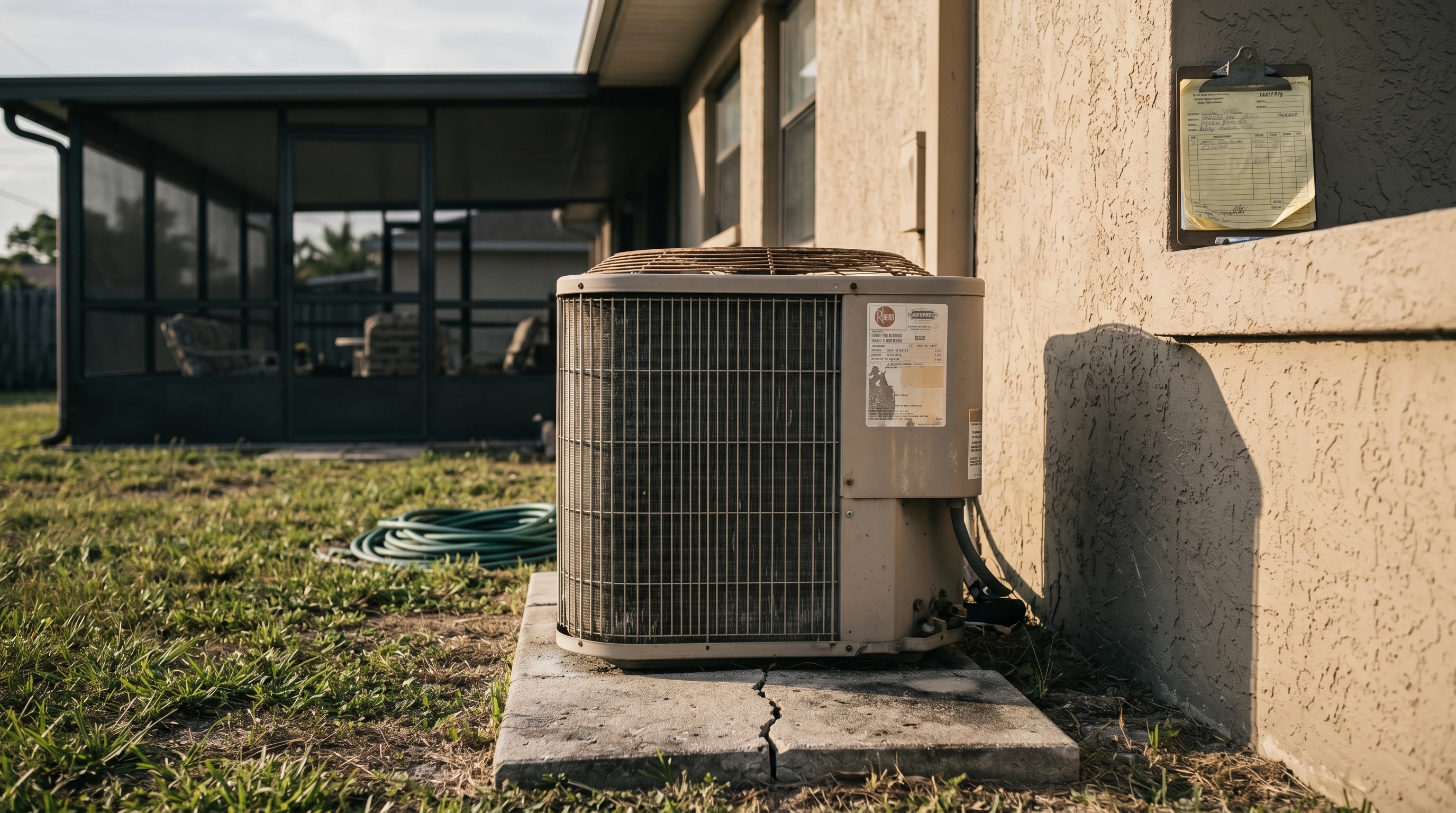
Coastal Florida HVAC equipment degrades faster than the national average. The combination of salt air, year-round humidity, and condenser coil exposure produces an estimated 20 to 30% shorter useful equipment life versus inland markets — a 10-year expected lifespan becomes 7 to 8 years, and a 15-year maximum becomes 11 to 12.
This changes the market in three measurable ways.
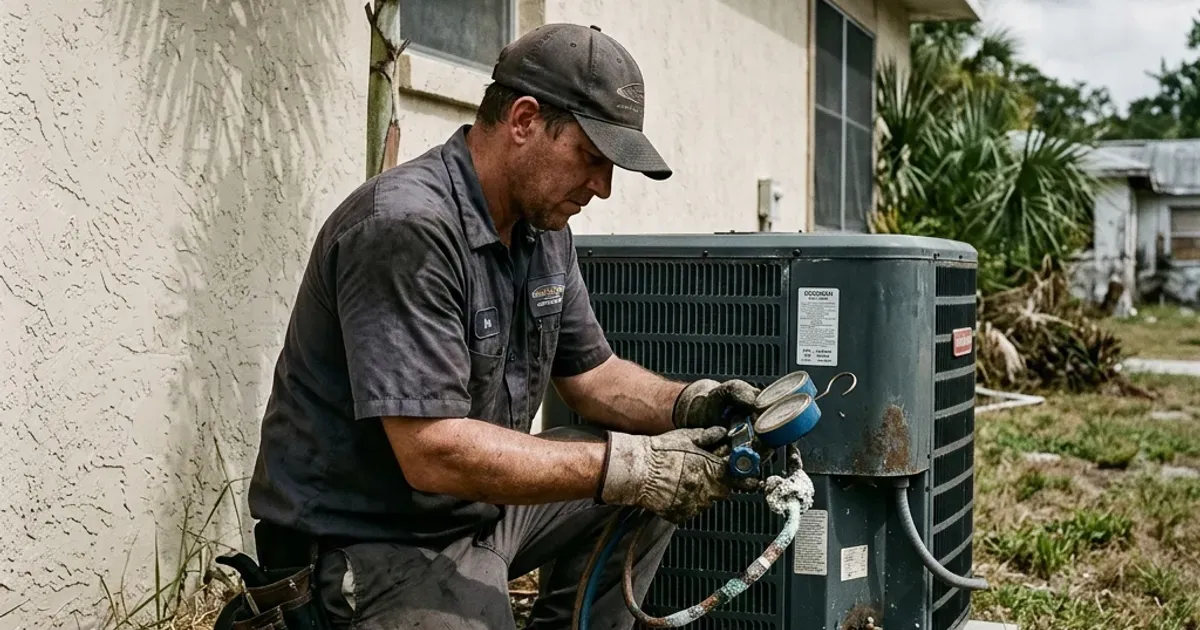
First, the replacement-to-repair revenue mix tilts toward replacement. A repair on a 9-year-old Tampa AC unit is often uneconomic — the coil is past its practical service life regardless of the specific failure mode. Operators who recognize this and sell replacement proactively capture ticket sizes 8 to 15x higher than a repair call.
Second, financing visibility becomes material. A replacement conversation is a $6,000 to $15,000 conversation for a typical residential system. Every operator in this set surfaces financing prominently on the homepage — three of them above the fold. Tampa buyers reach the financing question in the sales cycle faster than buyers in repair-dominant markets.
Third, warranty language matters more. Parts-and-labor warranties on new installations, extended labor warranty add-ons, and membership-based labor coverage all appear with greater prominence on Tampa operator websites than on inland operator sites. The buyer is making a bigger purchase and wants the downside protection in writing before they call.
For a Tampa operator whose homepage still looks like a repair-focused site — lead with repair pricing, mention replacement secondarily, bury financing in the footer — the conversion surface is misaligned with the market’s actual buying behavior.
The Snowbird Seasonality and What It Does to Dispatch
Tampa Bay’s population grows by roughly 200,000 seasonal residents between November and April. These are second-home owners, long-term rental residents, and full-season visitors — and they return to the same homes they left in the spring, which means their HVAC systems sit unused for six to seven months.
This produces a predictable service demand cycle no inland market experiences at this scale.
November and December: Startup failures spike. Seasonal residents return, turn on systems that have sat idle through Florida summer humidity, and discover mold growth, drain line clogs, capacitor failures, and refrigerant leaks that were invisible while the unit was off. The three weeks after Thanksgiving are often the highest-density service demand period of the year outside of peak summer.
April and May: Pre-shutdown service spike. Seasonal residents scheduling system checks, duct cleanings, and IAQ treatments before closing up for summer. This is a productized, scheduled demand channel — not an emergency response channel.
June through October: Peak summer demand, comparable to any Sun Belt market.
The operators who understand this seasonality have structured membership programs around it — spring pre-shutdown tune-ups, fall startup inspections, and year-round dehumidifier service. Cool Today and Del-Air both run membership structures that specifically price the snowbird pattern into their tiers.
For an operator not actively marketing to the seasonal resident segment, the November-December opportunity is particularly large. These homeowners return to failures, need help immediately, and do not yet have a local contractor relationship. The operator who shows up first in that window captures a multi-year relationship.
How Hurricane Season Shapes Emergency Availability Positioning
Tampa Bay’s named-storm season runs June 1 to November 30. Even storms that do not make direct landfall produce power outages, voltage surges, tree damage to outdoor units, and sustained flooding that destroys condenser units and refrigerant line sets.
Five of seven operators in this set prominently signal hurricane readiness or storm-response availability somewhere on their websites. Del-Air and Cool Today both maintain dedicated hurricane season landing pages with pre-storm and post-storm service checklists.
This is a Tampa-specific positioning element that inland operators do not have to solve for. A well-executed hurricane season content strategy captures search traffic in the weeks before and after named storms — traffic that is specifically shopping for an operator who understands storm-related HVAC damage and can respond within 48 hours of the all-clear.
Operators without a visible hurricane readiness layer on their websites are invisible during the specific windows (June cone projections, post-landfall cleanup) when Tampa homeowners are most actively searching for a reliable local contractor.
What Tampa Map Pack Leaders Do Differently Than Lower-Ranked Operators
Del-Air built its position on scale and standardization. A Florida-wide footprint allows them to amortize membership program infrastructure, technician training programs, and advertising spend across multiple metros — producing a price-competitive offering in Tampa with higher gross margin than a single-market operator can match at the same price point.
Cool Today concentrated on regional brand depth. Sixty+ years of continuous operation in the Tampa-Sarasota corridor produces brand recall that cannot be built in a short window regardless of marketing budget. Their homepage leads with vintage and family history more explicitly than most visible competitors.
Red Cap differentiated on design and brand experience. The website, uniforms, truck wraps, and communication layer are measurably above the Tampa category average. In a market where most operators look operationally similar from the outside, visible brand investment is itself a differentiator.
Ierna’s concentrated on submarket density in Pasco and north Hillsborough counties rather than metro-wide visibility. They are not trying to outrank Del-Air for “ac repair tampa fl” — they are dominating “ac repair wesley chapel” and “ac repair land o’ lakes” at lower total review counts.
The common thread is that each visible leader has chosen a specific axis — scale, vintage, brand investment, or submarket density — and built operational infrastructure that reinforces it. None of them are competing on generic quality claims.
How to Improve Your Tampa AC Repair Map Pack Ranking
Align your homepage with a replacement-heavy market. If your hero emphasizes repair pricing and financing is below the fold, you are optimizing for a buyer pattern Tampa does not have. Replacement cycle is shorter here. Buyers reach the replacement and financing conversation faster. Your site should too.
Start a review acquisition process if you haven’t. At a typical Tampa residential call volume of 10 to 18 jobs per week, a systematic post-job SMS review request can generate 180 to 320 new Google reviews in 12 months. In Tampa specifically, the review rating ceiling matters more than the count — prioritize 5-star review acquisition processes over volume maximization.
Pick a county and own it. Hillsborough, Pinellas, and Pasco function as three submarkets. An operator concentrated in one can hold visibility on that county’s queries with materially fewer reviews than a metro-wide operator requires. Choose the county where your proximity weight is strongest.
Build hurricane season content and service pages. Pre-storm preparation, post-storm damage assessment, and hurricane-specific maintenance inspection are all search categories with measurable volume in Tampa during the June-November window. Operators without this content are invisible during those searches.
Productize snowbird service. Pre-shutdown tune-ups in April/May and startup inspections in November/December are a scheduled, predictable service category. A dedicated landing page and a specific service package — not a line item on a menu — converts seasonal residents into ongoing membership customers.
The Competitive Landscape for Tampa HVAC Operators
Tampa looks easier to enter than Phoenix or Atlanta — review counts at the top are lower, the metro is smaller, and the visible leaders have not saturated review volume to the degree their peers in larger markets have.
That reading is only half right.
The barrier to entry in Tampa is not review count. It is the combination of salt air equipment expertise (which requires different repair protocols, different parts inventory, and different warranty language than inland operators carry), snowbird seasonal cadence (which requires operational staffing flexibility most single-market operators do not have), and hurricane season readiness (which requires pre-positioned inventory and surge capacity).
An out-of-market operator entering Tampa with a standard inland playbook will underperform a local competitor with half the review count. The local knowledge is the asset. The review count is the output.
For an established local operator who understands the salt air repair protocols, has structured membership around snowbird seasonality, and maintains hurricane-season surge capacity — the path to stronger visibility is straightforward. The Tampa market rewards operators who look specifically Tampa. Generic is the losing position.
We ran this exact analysis on a Clearwater residential operator competing in this market — visibility cone, review velocity, conversion surface audit, and financial gap estimate. See the full sample diagnostic output →
For full context on Google’s April 2026 review-policy update and how it now reweights ranking signals for HVAC profiles specifically, see Google’s April 2026 Reviews Crackdown: The HVAC Operator’s Action Plan.
Frequently Asked Questions
How many Google reviews do I need to rank for AC repair in Tampa?
The entry threshold for consistent Google Maps visibility on broad Tampa AC repair queries is approximately 1,500 to 2,500 reviews at a 4.8+ rating based on currently visible operators. On county-specific queries (Pinellas, Pasco, south Hillsborough), the threshold can be half that with concentrated geographic review density.
Does salt air really shorten HVAC equipment lifespan in Tampa?
Yes. Coastal Florida HVAC equipment degrades an estimated 20-30% faster than inland equipment due to salt air corrosion, year-round humidity, and condenser coil exposure. A 10-year inland lifespan becomes 7-8 years coastal. This shifts the revenue mix toward replacement sooner in the equipment cycle than in inland markets.
Why is financing more prominent on Tampa HVAC websites?
Tampa’s shorter equipment lifespan produces a replacement-heavy revenue mix. The average replacement conversation is $6,000-$15,000, and buyers reach the financing question earlier in the sales cycle. Every major visible Tampa operator surfaces financing prominently on the homepage — three above the fold.
How do Tampa HVAC operators handle snowbird seasonality?
The seasonal population swing (roughly 200,000 residents between November and April) creates predictable service demand: November-December startup failures and April-May pre-shutdown service. Operators like Cool Today and Del-Air productize these windows with dedicated membership pricing and scheduled service packages for seasonal residents.
Do Tampa HVAC operators need hurricane-specific marketing?
Yes. Five of seven top operators signal hurricane readiness or storm-response availability. Del-Air and Cool Today maintain dedicated hurricane season landing pages with pre-storm and post-storm service checklists. Tampa homeowners actively search for storm-ready contractors in the weeks before and after named storms — operators without this content are invisible during those windows.
How long does it take to build Google Maps visibility for HVAC in Tampa?
For an operator starting a systematic review acquisition process today, reaching the 1,500-review threshold for broad metro visibility typically takes 12 to 20 months at a call volume of 10 to 18 jobs per week. County-specific visibility (Pinellas, Pasco) can be achieved in 6 to 12 months with concentrated geographic review density.
Related market breakdowns: Houston, Atlanta, and Phoenix.
Related Markets
If you operate across Florida — or want to see how nearby HVAC markets compare against Tampa Bay — read these alongside this article:
Methodology
Review counts, ratings, and map pack positions were pulled directly from Google Maps on April 21, 2026, using a Tampa location context. Review counts above 5,000 are rounded to the nearest hundred. Homepage data reflects what was visible on company websites on the same date. Map pack position reflects a specific search at a specific time and will vary materially by proximity across the Tampa-St. Petersburg-Clearwater metro.
Three data points require independent verification: Cool Today’s 1963 founding year is drawn from their website. Salt air equipment lifespan estimates are based on HVAC industry manufacturer guidance and coastal service data, not a primary Built on Tenth study. Snowbird population estimates reflect Visit Tampa Bay and Tampa Bay Partnership published figures and are approximate.
If any data point in this article is influencing a business decision, verify the specific number before acting on it.
Built on Tenth is an independent HVAC market intelligence firm providing objective, data-backed diagnostic reporting for HVAC operators. We do not sell advertising, accept referral fees, or offer marketing agency retainers. Our loyalty is strictly to the data.