AUDITOR’S OVERVIEW
On April 16 and 17, 2026, Google rewrote the rules for Google Business Profile reviews. The update was quiet — no press conference, no banner notification — but the practical impact for HVAC operators is large. Practices that have been standard in the industry for a decade are now policy violations. Asking your tech to say “please mention my name in your review” is banned. Setting a monthly review quota for the team is banned. Standing a tablet at the dispatch counter so customers can leave a review before they walk out is banned.
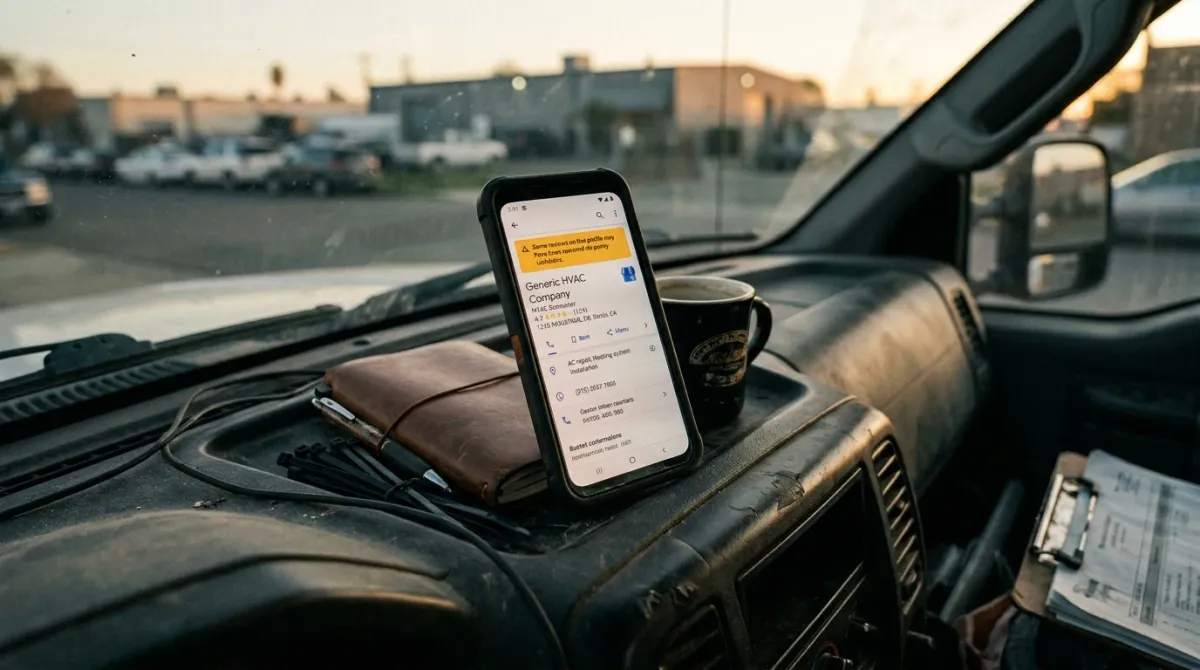
The penalties have teeth. Google’s enforcement is no longer just silently filtering reviews. Profiles in violation can now display a public warning banner that tells every visitor “fake reviews were removed from this profile” — a trust signal that is harder to recover from than a single bad review.
This piece breaks down what changed, why it changed, and the specific operational moves HVAC owners need to make in the next two weeks to avoid being caught in an enforcement wave that has already started removing reviews at record rates.
THE BOTTOM LINE
The April 2026 update made five things explicitly prohibited that were not previously enforced:
- Asking customers to mention specific employee names in reviews
- Internal staff review quotas or contests
- Handing customers a tablet at checkout to write a review on the premises
- Offering any incentive (discount, free service, cash) for reviews
- Soliciting reviews from anyone other than the actual paying customer
Per Google’s 2025 Trust and Safety Report, 292 million policy-violating reviews were blocked or removed in 2025, alongside 13 million fake Business Profiles, 79 million inaccurate edits to listings, and 783,000 abusive accounts restricted. That is the scale of the enforcement infrastructure operating now. Gemini AI is moderating reviews before publication, not just after, which means coordinated review campaigns are detected before they ever appear.
For HVAC operators, the practical work is: audit your current review-request process this week, retrain technicians and CSRs on the new rules within two weeks, and rebuild your review pipeline around behavioral authenticity rather than volume. Shops that move fast keep their profiles clean. Shops that keep running 2025 playbooks risk a public warning banner.
The April 16-17 Policy Earthquake
Google made two distinct policy changes on consecutive days. On April 16, 2026, Google published its 2025 Trust and Safety Report and rolled out three new Google Maps protection features powered by Gemini AI. On April 17, Google quietly added two new clauses to the Maps Rating Manipulation policy. Together, these two days redefined what “asking for reviews” can legally look like in 2026.
The shift is structural. The 2025 review-collection playbook centered on volume and personalization — get as many reviews as possible, name-drop the tech, deploy review-station tablets, run staff contests. The 2026 playbook centers on authenticity and behavioral signals. Google now treats most of the 2025 tactics as manipulation.
For HVAC operators, this matters more than for most local businesses. HVAC has historically been one of the heaviest review-solicitation industries — the average installation produces a captive customer for several hours, the ticket is high enough to incentivize aggressive review collection, and competitive pressure in the map pack rewards review velocity. All of those structural conditions also make the industry one of the most exposed to the new enforcement.
What’s Now Banned in Detail
1. Staff Name Mentions in Review Requests
For at least a decade, the standard HVAC review-collection ask has been some version of: “If you were happy with the service, please leave a Google review and mention [Tech Name] — it really helps him out.” Google now treats this as directing review content. It is a violation under the updated Rating Manipulation policy.
The reasoning: if you are coaching reviewers on what specific elements to mention, you are shaping the review rather than collecting an organic one. The policy applies whether the ask is verbal at the kitchen table, written on a leave-behind card, embedded in a follow-up email, or sent in a text.
What to change: Drop tech-name asks from every channel — leave-behinds, email templates, SMS templates, voicemail scripts. Train technicians to ask for honest feedback only, with no scripted prompts for specific content.
2. Internal Staff Review Quotas and Contests
Quotas like “every tech needs to bring in 3 reviews this week” or contests like “the tech with the most 5-star reviews this month gets a $200 bonus” are now explicit violations. Google’s reasoning is that quota and contest structures incentivize techs to manipulate review collection — pressuring customers, ghost-writing reviews, soliciting from non-customers.
What to change: Remove all volume-based review goals from technician compensation and performance reviews. If reviews are a component of performance evaluation, frame them as a customer-experience signal, not a volume target.
3. On-Premises Review Stations
Handing a customer a tablet, having a kiosk in your office lobby for reviews, or asking the customer to leave a review before the technician departs is now a violation. The reasoning: reviews left under business-presence pressure are not authentic to the customer’s actual experience over time.
What to change: Stop all on-truck and in-office review collection. The review request needs to happen after the technician has departed and the customer has had time to assess the work in their own environment.
4. Incentives for Reviews
This was already largely prohibited but is now explicitly enumerated. Offering any incentive — discounts, free maintenance visits, gift cards, raffle entries, future service credits — in exchange for posting, revising, or removing a review is a violation.
What to change: Audit every customer-facing offer. Anything that reads as “leave us a review and get X” needs to come down today. This applies to social media, email signatures, website footers, and physical leave-behinds.
5. Soliciting Reviews From Non-Customers
Asking friends, family, employees, or anyone who did not actually pay for service to leave a review is a violation. This is harder to detect at the individual level, but Gemini’s coordinated-campaign detection systems are explicitly tuned to spot this pattern.
What to change: No more “ask the team to leave reviews,” no more soliciting from friends-of-friends. Reviews come from actual paying customers only.
The Public Warning Banner Is the New Penalty
The enforcement consequence that has changed most dramatically is the public warning banner.
Per Google’s Business Profile help documentation, profiles that violate the Rating Manipulation policy can be subjected to escalating restrictions: temporary loss of the ability to receive new reviews, temporary unpublishing of existing reviews, and a public warning banner displayed on the profile stating that fake reviews were removed.
The banner is the punishment with the longest tail. A short period of review suspension recovers when the suspension lifts. A public banner stating that fake reviews were removed sits on the profile and tells every prospective customer — homeowners shopping for emergency AC repair on a Saturday afternoon — that the business was found to be manipulating reviews. The trust signal is harder to repair than a few bad reviews would be.
There is no public list of how many businesses have received the banner. Local SEO practitioners reporting on the post-update wave note widespread review removals and an unknown but growing number of public warning displays. The enforcement is happening faster than the documentation can keep up.
The Gemini Moderation Layer
The infrastructural change behind all of this is Google’s deployment of Gemini AI as the moderation layer. The relevant capabilities, per Google’s April 16, 2026 announcement:
- Pre-publication moderation. Reviews are now scanned before they post, not just after. Coordinated campaigns and pattern-matching content can be blocked before ever appearing.
- Coordinated campaign detection. Gemini specifically watches for clusters of reviews from connected accounts, similar phrasing patterns, geographic anomalies (reviews from accounts that have never been near the business location), and suspicious timing.
- Review extortion detection. Patterns where bad reviews are followed by removal-payment demands are now actively flagged.
- Edit and update verification. Suggested edits to business hours, attributes, and information are scanned for accuracy and bad-faith manipulation.
In 2025, Google blocked 79 million inaccurate edits and restricted over 783,000 abusive accounts (Google blog, April 16, 2026). The moderation infrastructure is at scale and operating in real time.
The Shops That Move Fast Keep Their Profiles. The Ones Running 2025 Playbooks Are Already Getting Penalized.
Audit your current Google Business Profile signal strength against the new authenticity standards before the next enforcement wave.
AUDIT YOUR MAP PACK POSITION →Ask Maps and the Death of Traditional Q&A
The other piece of the 2026 update is what Google is doing with the user-facing search experience itself. Two changes matter for HVAC operators:
Ask Maps launched March 11, 2026. Per Google’s official announcement, Ask Maps is a Gemini-powered conversational layer inside Google Maps that lets users ask hyper-specific natural-language questions. A homeowner can now ask Maps “which HVAC company near me has fast emergency service for AC repair on a Saturday” or “find a heating contractor with good reviews for furnace replacement in older homes.” The AI synthesizes reviews, profile data, attributes, and web content to answer.
The implication for HVAC operators: profile depth and review content quality now matters more than review volume. A profile with 50 detailed reviews mentioning specific service types, equipment brands, and emergency response times outperforms a profile with 200 generic five-star reviews when Ask Maps is constructing an answer to a specific homeowner question.
Traditional Q&A is being retired. The user-generated Q&A section on profiles is being replaced by AI-generated answers pulled from your reviews, your website, and your profile attributes. Owner-controlled Q&A as a content strategy is going away.
The implication: your website and your profile attributes now feed the answers Google’s AI gives prospective customers about your business. If your website does not clearly list which equipment brands you service, which neighborhoods you cover, and which service types you offer, the AI cannot generate accurate answers and your visibility in conversational queries drops.
The Behavioral Signals Shift
Google has been moving in this direction for years, but the 2026 update accelerates it. Ranking is now heavily influenced by what real users actually do with your profile:
- Click-through rate from search results to your profile
- Direction requests from your profile
- Phone calls placed from your profile listing
- Photos viewed on your profile
- Profile-to-website clicks
A profile that ranks high in the map pack but generates few clicks, calls, or directions will lose ranking over time. The behavioral signal layer is now strong enough that traditional citation building (listing your business on directories) produces near-zero ranking lift if the profile itself is not generating engagement.
The corollary: investing in profile photos, posts, attribute completeness, and review response quality (how you reply to reviews) directly affects ranking through the engagement layer. The work to look credible is the work that ranks.
The Authenticity Premium
Google’s 2026 trust scoring penalizes generic and AI-generated visual content. Profiles using stock photos, generic equipment shots, or obvious AI-generated images are seeing measurable trust drops. The 2026 standard:
- Real photos of your team and trucks in branded uniforms, on actual jobs
- Recent installation photos with date metadata intact
- Service area imagery from the neighborhoods you actually serve
- Equipment brand authenticity — photos showing the actual brands you service
For HVAC specifically, this is a meaningful operational change. Most HVAC profiles are visually thin — a logo, a generic AC unit photo, maybe a stock truck. Profiles that build a deep library of authentic field photos (with technician faces blurred or anonymized for privacy) are visibly outperforming generic profiles in 2026 ranking data.
Entity Authority and Cross-Source Consistency
Google now treats your business as an “entity” verified across the web. The signal logic: if your Google Business Profile lists “AC repair, furnace installation, ductwork cleaning, indoor air quality” as services, Google’s AI checks your website to verify those services are actually offered. If your website only describes AC and heating without mentioning ductwork or IAQ, the AI lowers your trust score and the breadth of queries you can rank for.
The practical work:
- Your website’s service pages should mirror your GBP service list exactly
- Your local landing pages (per neighborhood, per city) should reinforce service area attributes
- Your business name, address, and phone (NAP) should be consistent across your website, GBP, and any directories
- Hours, attributes, and operating details should match across sources
Inconsistency between sources lowers entity trust. Consistency raises it. The 2026 ranking logic treats consistency as a baseline trust signal, not an optimization.
New Native Tools You Should Be Using
Two GBP capabilities rolled out alongside the policy changes that are worth deploying:
Native post scheduling. As of November 2025 and now broadly available, Google Business Profile supports scheduling Updates, Offers, and Events natively in the dashboard — no third-party tool needed. Bulk scheduling and multi-location posting are also now supported.
Proactive edit alerts. Google now sends verified business owners email alerts when users suggest edits to your business hours or info. With over 80 million inaccurate user edits in 2025, this matters — a customer suggesting “this business closed permanently” can now be intercepted and rejected by the owner before it goes live.
The HVAC 2026 Action Plan
Here is what to do in your shop this week:
Day 1 (today):
- Audit every customer-facing review request for tech-name mentions, on-premises asks, and incentive language. Take any non-compliant material down today.
- Check your Google Business Profile for the public warning banner. If present, work with a local SEO specialist to understand the underlying violation immediately.
- Compare your current review count to 60 days ago. A sudden drop indicates Google has already removed reviews under the new policy.
Within 2 weeks: 4. Retrain every technician and CSR on the new review-request rules. Update voicemail scripts, leave-behind cards, follow-up email templates, and SMS templates. 5. Remove all volume-based review quotas from compensation and performance review structures. 6. Audit your website service pages against your GBP service list. Bring them into alignment.
Within 30 days: 7. Build a library of 30+ authentic field photos for your profile (trucks, technicians anonymized, real installation work). 8. Implement native post scheduling for weekly GBP updates. 9. Verify your owner email is current so proactive edit alerts route correctly. 10. Audit review response quality on your last 50 reviews. AI-driven trust scoring weighs response quality and timing.
Ongoing: 11. Track behavioral signals in Google Business Profile insights — clicks, calls, direction requests, photo views. These now feed ranking directly. 12. Build review velocity through actual service quality, not solicitation pressure. Authentic high-quality reviews are now the only durable strategy.
For a deeper view of how these signals tie into your overall map pack standing, see Google Business Profile Audit for HVAC and HVAC Google Map Pack Ranking.
Frequently Asked Questions
Can I still ask my HVAC customers to leave a Google review in 2026?
Yes — asking for a review is still allowed. What is now prohibited is directing the content of the review. You cannot ask the customer to mention a specific technician by name, mention specific service details you want them to highlight, or give them a script. The ask itself is fine. The coaching is not.
Will my HVAC company get a public warning banner if I have fake reviews?
Per Google’s Business Profile help documentation, profiles in violation of the Rating Manipulation policy can be subject to escalating restrictions, including a public warning banner stating that fake reviews were removed. The banner is the most damaging penalty — every prospective customer sees it. The way to avoid it is to comply with the new rules: no name-mention asks, no quotas, no incentives, no on-premises tablets, no soliciting non-customers.
What is “Ask Maps” and how does it affect my HVAC business?
Ask Maps is a Gemini-powered conversational AI feature inside Google Maps, launched March 11, 2026 in the US and India. Users can ask hyper-specific questions (“which HVAC company near me has fast emergency service”) and Gemini synthesizes reviews, profile data, and web content to answer. The implication for HVAC operators: review content quality, profile attribute depth, and website service-page detail now matter more than review volume alone, because the AI uses all three to construct answers.
Why are my Google reviews disappearing?
Google’s 2025 Trust and Safety Report disclosed that 292 million policy-violating reviews were blocked or removed in 2025 alone, with enforcement intensifying after the April 16-17, 2026 policy update. If reviews on your profile are disappearing, the most likely causes are: prior reviews collected with name-mention coaching, reviews left from non-customer accounts, reviews tied to incentive offers, or reviews flagged by Gemini’s coordinated-campaign detection. Compare your review count to 60 days ago to gauge the scale of the impact.
Are Google review quotas for HVAC technicians illegal in 2026?
Yes, internal staff review quotas and contests are now explicit violations of Google’s Rating Manipulation policy as of April 17, 2026. This includes any monthly target for review counts, performance review components based on review volume, and bonus structures tied to review collection. Reviews can still be tracked as a customer-experience signal, but cannot be a volume-based metric tied to compensation.
How do I know if my HVAC profile has been penalized?
Two clear signals: (1) a sudden drop in your visible review count compared to 30-60 days ago, indicating reviews were removed by Google’s enforcement systems, and (2) a public warning banner displayed on your profile stating that fake reviews were removed. Check both today. Local SEO practitioners are reporting widespread enforcement waves since the April update.
Can I still use my logo and stock photos on my Google Business Profile?
Logos are fine and expected. Stock photos and AI-generated images are now penalized in trust scoring. The 2026 standard expects authentic photos of your team, trucks, equipment, and recent work. Build a library of real field photography to replace any generic or stock content currently on your profile.
Sources
- Google. New ways we’re protecting businesses on Maps. Official Google blog post, April 16, 2026. Includes the 2025 Trust and Safety Report figures (292 million reviews blocked or removed, 13 million fake Business Profiles removed, 79 million inaccurate edits blocked, 783,000 abusive accounts restricted). blog.google/products-and-platforms/products/maps/new-ways-were-protecting-businesses-on-maps
- Google. Ask Maps and Immersive Navigation: New AI features in Google Maps. Official Google blog post, March 11, 2026. blog.google/products-and-platforms/products/maps/ask-maps-immersive-navigation
- Google. Business Profile restrictions for policy violations. Official Google support documentation. Describes the escalation path for restrictions including the public warning banner. support.google.com/business/answer/14114287
- Search Engine Roundtable. Google Updates Google Business Profile Review Policies. Coverage of the April 17, 2026 policy clause additions. seroundtable.com
- Search Engine Land. Google Maps turns exploration into a conversation with Ask Maps. searchengineland.com
- Search Engine Journal. Google Maps Launches AI Conversational Search With Ask Maps. searchenginejournal.com
- TechCrunch. Google Maps is getting an AI ‘Ask Maps’ feature and upgraded ‘immersive’ navigation. March 12, 2026.
- Built on Tenth. Google Business Profile Audit for HVAC. /hvac-research/google-business-profile-audit-hvac
Methodology note: where this article describes specific consequences of the April 16-17, 2026 policy update, claims trace to Google’s official blog announcements and Business Profile support documentation. Where the article discusses HVAC-specific operational implications, those are interpretations based on the documented policy changes applied to standard HVAC review-collection practice, not direct Google guidance.
Built on Tenth is an independent HVAC market intelligence firm providing objective, data-backed diagnostic reporting for HVAC operators. We do not sell advertising, accept referral fees, or offer marketing agency retainers. Our loyalty is strictly to the data.