AUDITOR’S OVERVIEW
The wage question is the easy half. BLS publishes it. Recruiters quote it. Operators benchmark against it. The hard half — the half that actually decides whether a $1.5M HVAC operation runs at 12% net margin or 4% — is the pay-plan structure.
Two shops paying the same average $32/hr to their lead techs can produce wildly different P&Ls. One pays straight hourly and watches techs slow-walk profitable jobs. The other pays a spiff structure and watches techs upsell every call until the average ticket inflates and the close rate collapses. A third pays revenue-share and watches the lead tech earn $140K while the installer earns $48K and the helper quits. Same wages. Different incentives. Different businesses.
This piece covers both halves. Public BLS wage data for the wage question. Structural breakdown plus modeled margin math for the pay-plan question. The structural decision is the one that compounds.
THE BOTTOM LINE
Per the U.S. Bureau of Labor Statistics May 2024 Occupational Employment Statistics for HVAC Mechanics and Installers (code 49-9021), national wage benchmarks sit roughly here:
- 10th percentile:
$17.71/hr ($36,840/yr) - 25th percentile:
$21.87/hr ($45,490/yr) - Median: $27.51/hr (~$57,200/yr)
- 75th percentile:
$35.00/hr ($72,800/yr) - 90th percentile: $42+/hr ($87,600+/yr)
Top-paying states (Alaska, Massachusetts, New Jersey, Washington, DC, Connecticut) run 20-35% above national medians. Low-cost rural and Southern markets run 10-20% below.
Wage rate is the floor. Pay-plan structure is what determines whether your loaded labor cost lands at 22% of revenue (healthy) or 38% of revenue (bleeding). The five common HVAC pay plans each produce different tech behavior, different ticket size, different close rate, and different margin outcomes. Choosing the structure is the actual leverage point.
The Wage Benchmark
The BLS data above is the cleanest publicly-available wage benchmark for HVAC technicians. A few details that matter when reading the numbers:
The percentiles tell you the shape of the labor market. A 10th-percentile tech ($17.71/hr) is almost always an apprentice, a first-year helper, or a tech in a low-wage rural market. A 90th-percentile tech ($42+/hr) is a senior lead in a high-cost coastal metro, often union, often with 15+ years of experience. The vast majority of working residential HVAC techs sit between the 25th and 75th percentile — $21.87/hr to $35/hr.
Top-paying states reflect cost of living, union density, and licensing barriers. Alaska, Massachusetts, and Connecticut top the list partly because of HCOL and partly because licensing requirements restrict supply. The same skill produces a 30%+ wage premium in those markets compared to comparable Southern markets.
The mean ($29.27/hr) sits above the median ($27.51/hr) because the top end pulls the distribution. A handful of senior techs at $50+/hr distort the average. The median is the more useful number for benchmarking your roster.
Loaded cost is 1.25 to 1.4x base wage once payroll taxes, benefits, workers’ comp, PTO, and equipment are included (BLS Employer Costs for Employee Compensation series). A tech at $30/hr base is roughly $40-$42/hr fully loaded.
For most residential HVAC operations, a competent lead tech in 2026 costs $32-$38/hr base in mid-cost markets, or $42-$50/hr loaded. Below that, you are competing for talent with the lower 25% of the market. Above that, you are paying senior-lead wages and should expect senior-lead output.
The Five Pay Plan Structures
Every HVAC tech pay plan is a variation of one of these five structures. Each rewards specific tech behavior. Each fails in a specific way.
1. Straight Hourly
The simplest plan. Tech is paid per hour worked. No bonus, no commission, no production tie.
What it rewards: Showing up. Hours billed. Clean callbacks (because the tech does not benefit from cutting corners).
What it fails to reward: Speed, ticket size, sales conversion, customer retention. A tech on straight hourly has zero financial reason to recommend a maintenance agreement, present a replacement quote, or upsell a parts package.
Best fit: Apprentices, install helpers, second-year techs still learning. Anyone whose primary job is to do the work, not to grow the ticket.
Wage range: $17-$25/hr base for apprentice and helper roles, $24-$32/hr for journeyman techs on hourly.
2. Hourly Plus Spiff
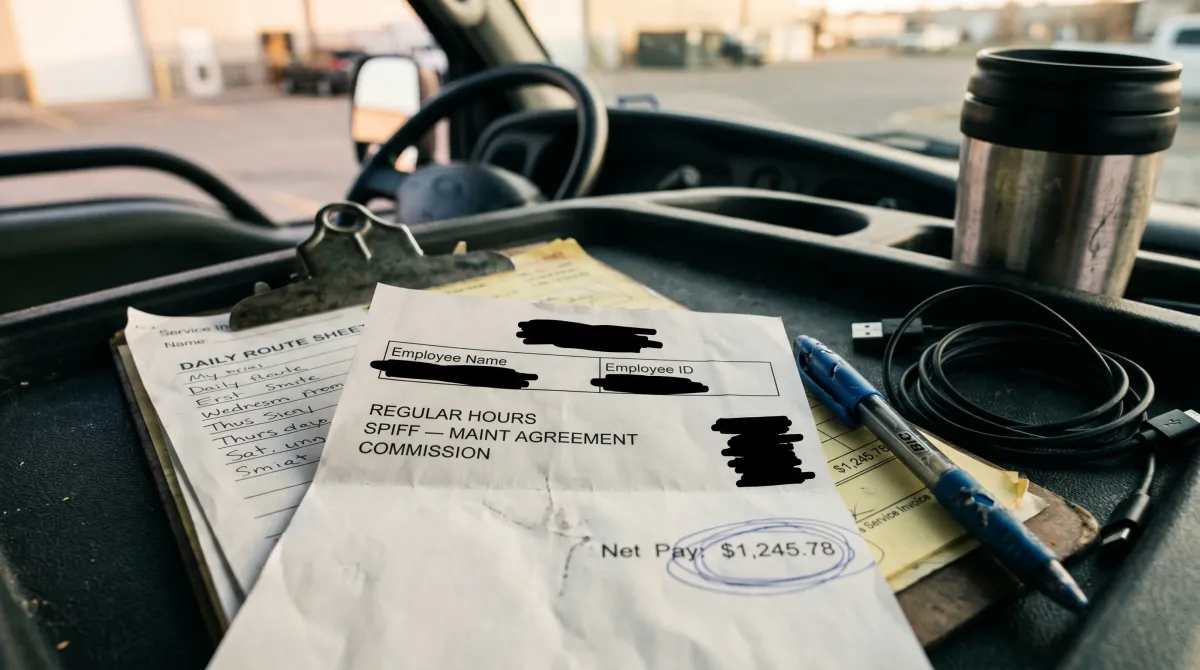
A small per-job or per-task bonus on top of hourly. Common spiffs: $25 per maintenance agreement sold, $50 per same-day repair closed, $100 per replacement quote that converts.
What it rewards: The specific behavior the spiff targets. Done well, it nudges the tech toward presenting options, asking the booking question on agreement signups, and closing repairs same-visit.
What it fails to reward: Anything not on the spiff list. Techs on spiff plans optimize for spiff-eligible work and de-prioritize non-spiff calls.
Margin failure mode: Spiff drift. Adding a $50 spiff on every behavior eventually produces a tech earning $20+/hr in spiffs on top of hourly, but the spiffs are rewarding behavior the tech would have done anyway. The shop is paying twice for the same outcome.
Best fit: Mid-experience techs (year 2-5) who need a behavioral nudge but are not yet ready to manage their own ticket independently.
Wage range: $24-$32/hr base plus $200-$1,000/mo in spiffs depending on call volume and conversion.
3. Hourly Plus Commission on Parts and Services
Tech earns hourly plus a percentage commission on parts sold or service revenue produced. Typical structures: 5-10% on parts, 3-5% on labor revenue, sometimes capped.
What it rewards: Ticket size on every call. The tech has direct incentive to recommend higher-margin parts, present full repair quotes rather than minimum fixes, and convert diagnostic calls to same-visit repairs.
What it fails to reward: Customer trust on the long arc. Aggressive commission structures produce techs who push every call toward maximum ticket — sometimes at the cost of recall risk, online reviews, and repeat-customer rate.
Margin failure mode: Inflated tickets that erode close rate. A tech who quotes $1,800 of repairs on a call where the homeowner expected $400 produces high revenue per closed call but a low percentage of calls that close. Net revenue can be flat or down even with higher per-call ticket.
Best fit: Confident senior techs in shops with strong CSR booking, where the tech is the primary point of customer trust on-site.
Wage range: $26-$34/hr base plus 4-8% commission, typically yielding $1,500-$5,000/mo in commission for active techs.
4. Performance Pay / Revenue-Share
Tech is paid a percentage of the revenue they personally produce. Common structures: 10-15% of all billed revenue (parts and labor combined), or 8-12% of installed revenue plus separate commission on parts.
What it rewards: Total revenue produced per tech. Aligns the tech’s economic interest fully with the shop’s. The tech earning more means the shop earning more, in lockstep.
What it fails to reward: Anything that does not directly produce revenue. Maintenance work (low ticket, low margin) gets neglected. Installation cleanup, customer education, callback prevention, and apprentice mentoring all become invisible work.
Margin failure mode: Pay compression at the top and disengagement at the bottom. The lead tech earns $140K. The install helper earns $48K and watches the lead earn 3x without doing 3x the work. Apprentices quit because they cannot earn meaningfully under the structure. The roster becomes top-heavy.
Best fit: Senior selling techs / comfort consultants whose primary role is closing replacements. Less suitable for a mixed-experience tech roster.
Wage range: No hourly base in pure form, or low hourly ($18-$22/hr) plus 10-15% revenue share. High earners in the structure clear $90K-$150K. Low producers in the structure clear $40K-$50K and turn over.
5. Salary Plus Bonus on KPIs
Fixed annual salary plus quarterly or monthly bonus tied to specific KPIs: average ticket, close rate, callback rate, customer review rate, agreement conversion rate.
What it rewards: Multi-dimensional performance. The KPI bonus structure can balance ticket growth against callback rate against customer satisfaction in a way commission and revenue-share cannot.
What it fails to reward: Volume. A salary tech who hits all KPIs on 60 calls per month earns the same as one who hits them on 90 calls per month. Production capacity is decoupled from pay.
Margin failure mode: Comfort. Salaried techs without strong direct management often coast at the minimum performance level needed to hit the KPI bonus. The structure works best in shops with disciplined reporting and direct daily management. It works poorly in shops where the owner is the dispatcher and there is no operations layer.
Best fit: Senior leads, service managers, or technical operations roles. Rarely a fit for a residential field tech directly.
Wage range: $65,000-$95,000 salary plus $5,000-$15,000 annual bonus tied to KPI achievement.
Your Pay Plan May Be the Reason Your Margin Is Where It Is.
A diagnostic of your shop's labor cost as % of revenue, ticket size by tech, and callback rate is the cleanest way to identify whether your pay plan is misaligned.
GET THE DIAGNOSTIC →The Modeled Math at $1.5M Revenue
Same shop. $1.5M annual revenue. 4-tech roster (1 lead, 2 journeymen, 1 apprentice). The pay plan changes. Everything else holds constant.
These are illustrative models — your actual numbers will vary based on local wages, mix, and burden rates. The point is the relative pattern across plans, not the absolute dollar.
Assumed loaded cost per $1 of base wage: $1.30 (BLS ECEC range). Assumed shop call mix: 50% repair, 25% maintenance, 25% replacement.
Plan A: Straight Hourly Roster
- Lead tech: $32/hr × 2,080 hrs × 1.30 loaded = $86,500
- 2 journeymen at $26/hr × 2,080 × 1.30 = $70,300 each = $140,600
- Apprentice at $19/hr × 2,080 × 1.30 = $51,400
- Total loaded labor: $278,500 = 18.6% of revenue
Output: low ticket size, low close rate, comfortable techs, low callback rate. Revenue typically caps below the model — same labor cost, less revenue produced. Real shop running this plan typically lands at $1.1-$1.3M, not $1.5M.
Plan B: Hourly Plus Spiff Roster
- Same hourly base as Plan A: $278,500
- Spiff load:
$15,000 across roster ($1,250/mo, taxes/burden absorbed) - Total loaded labor: $293,500 = 19.6% of revenue
Output: better ticket-presentation behavior on targeted spiffs (agreements, same-day repair). Modest revenue lift over Plan A — typically 5-12%. Margin slightly compressed by spiff cost but offset by revenue lift.
Plan C: Hourly Plus Commission Roster
- Lead at $30/hr base × 2,080 × 1.30 = $81,100
- 2 journeymen at $24/hr × 2,080 × 1.30 = $64,900 each = $129,800
- Apprentice at $19/hr × 2,080 × 1.30 = $51,400
- Commission load: 5% of $1.5M revenue = $75,000 (taxes/burden absorbed)
- Total loaded labor: $337,300 = 22.5% of revenue
Output: highest ticket size of the five plans. Highest revenue produced if close rate holds. Margin pressure if commission incentivizes over-quoting and close rate drops. Healthy version of this plan delivers 22-25% labor as % of revenue with strong close rate. Unhealthy version delivers 25%+ with eroding close rate and rising callback rate.
Plan D: Pure Revenue-Share Roster
- Lead tech: 12% of $700K personal production = $84,000 (no hourly base)
- 2 selling techs: 10% of $400K personal production each = $40,000 base + production
- Install helper at $20/hr × 2,080 × 1.30 = $54,100
- Total loaded labor: $258,100 = 17.2% of revenue, but revenue is heavily concentrated
Output: top tech earns the most. Apprentice/helper earnings depressed. Production volume on selling roles can be high but turnover risk on lower-paid roles is significant. Plan tends to bleed margin not through labor cost but through training cost (replacing turnover) and retention.
Plan E: Salary + KPI Bonus Roster
- Lead salary: $80,000 + $10,000 bonus = $90,000 × 1.30 = $117,000 loaded
- 2 journeymen at $26/hr hourly = $140,600 (same as Plan A)
- Apprentice at $19/hr = $51,400
- Total loaded labor: $309,000 = 20.6% of revenue
Output: best when there is real management oversight on the KPI structure. Worst when the owner-dispatcher is the only manager and KPIs go un-reviewed. The plan adds 2 percentage points of labor cost over Plan A in exchange for KPI accountability — only worth it if the accountability is real.
The pattern: labor as % of revenue moves between 17% and 23% across the five plans. The 6-point swing is meaningful — at $1.5M revenue, that is $90K per year. The plan choice is roughly the size of one full-time tech’s loaded cost.
The Tech Ladder
A residential HVAC roster typically runs three tiers:
Apprentice / Install Helper ($17-$22/hr base, hourly almost universally). First 12-24 months. Pay is below median because the tech is producing below median. Standard plan: hourly with optional small spiffs to encourage learning behavior.
Journeyman / Service Tech ($24-$32/hr base, hourly or hourly+spiff). Years 2-7. Capable of handling most diagnostic and repair work independently. Pay sits in the 25th-75th BLS percentile range. Plan choice depends on shop philosophy — hourly+spiff is the most common.
Senior Lead / Selling Tech ($32-$45/hr base, often with commission or revenue share). Year 7+. Capable of handling complex troubleshooting, presenting replacement options, and producing high ticket on every call. Pay sits in the 75th-90th BLS percentile range, often higher with commission. Plan choice usually shifts to commission or revenue-share at this tier because the tech’s behavior is what produces ticket size.
The compression problem most shops run into: paying senior-lead wages without a senior-lead pay plan. A $42/hr lead on straight hourly is being paid for output the plan does not require them to produce. Either the wage is too high for the plan, or the plan is too soft for the wage.
How to Know Your Pay Plan Is Bleeding Margin
Five signals:
- Labor as % of revenue is above 25% on a healthy mix. Healthy residential HVAC labor cost runs 18-23% of revenue. Above 25% is a structural issue, not a wage issue.
- Top tech earns 2.5x or more what your apprentice earns and the apprentice is turning over. Compression risk. Either close the gap or accept the recruiting cost.
- Average ticket has not moved in 18 months despite price increases. Pay plan is not rewarding ticket-growth behavior. Either the plan is too soft (no incentive) or too aggressive (techs are over-quoting and dropping close rate).
- Callback rate is rising. Often a signal that aggressive ticket-growth incentives are pushing techs to recommend work that does not need to be done, or to skip diagnostic steps to close calls faster.
- Tech turnover above industry norm. HVAC tech turnover typically runs 15-25% annually. Above 30% means either the wage is below market or the plan is producing the wrong behavior. Both are pay-plan diagnostics.
If two or more of those signals are present, the pay plan is the lever to examine — not the wage rate. Most owners try to fix the symptom (raise wages) when the structure is the issue.
Frequently Asked Questions
How much does an HVAC technician make per hour in 2026?
Per BLS Occupational Employment Statistics (May 2024, code 49-9021), the median hourly wage for HVAC mechanics and installers is $27.51 and the mean is $29.27. The 25th percentile is roughly $21.87/hr, the 75th percentile is roughly $35/hr, and the 90th percentile sits above $42/hr. Top-paying states (Alaska, Massachusetts, New Jersey, Washington, DC, Connecticut) run 20-35% above national medians.
What is the best pay plan for HVAC technicians?
There is no single best plan — the right structure depends on the tech’s experience and the shop’s management capacity. Apprentices and helpers fit straight hourly. Mid-career journeymen fit hourly plus spiff. Senior selling techs fit commission or revenue-share. Salary-plus-KPI works for senior leads in shops with real management oversight. Most healthy residential operations run a mix across the roster.
What is a healthy labor cost as a percentage of revenue for an HVAC company?
Healthy residential HVAC operations run loaded field labor at 18-23% of revenue. Above 25% indicates either wage rates above market, the wrong pay-plan structure for the work mix, or low revenue per tech. Below 17% on a residential mix often indicates underpaid techs, high turnover risk, or unsustainable revenue concentration on a small number of senior techs.
Should HVAC technicians be paid hourly or commission?
Hourly is the safer default and the right choice for apprentices and journeymen. Commission and revenue-share work for senior selling techs whose primary role is closing high-ticket work. The risk of commission plans is over-quoting that erodes close rate. The risk of pure hourly plans is undermotivated ticket growth. A common compromise — hourly plus spiff — captures most of the upside of incentive pay without the close-rate risk.
What is the average HVAC technician salary?
Per BLS May 2024 data, the mean annual wage for HVAC mechanics and installers is approximately $60,860, and the median is approximately $57,200. With overtime, spiffs, and commission included, working journeyman techs in 2026 typically earn $55,000 to $80,000. Senior leads on commission or revenue-share plans regularly clear $90,000 to $130,000+.
How do I know if my HVAC tech pay plan is the problem?
Five signals: labor cost above 25% of revenue, top-to-bottom pay compression with apprentice turnover, flat ticket size despite price increases, rising callback rate, and turnover above 30% annually. Any two of those simultaneously usually points at pay-plan structure rather than wage level. The fix is a structural redesign, not a wage increase.
Should I pay HVAC techs a flat rate per job?
Pure flat-rate / piece-rate pay is uncommon in residential HVAC service work — it works better for installation crews where the scope is well-defined and the time is predictable. For service and repair calls where time per call varies dramatically, flat-rate per-job pay produces incentives to rush work, which raises callback rate. Most residential operators who consider flat-rate end up implementing hourly-plus-spiff or hourly-plus-commission instead.
Sources
- U.S. Bureau of Labor Statistics. Occupational Employment and Wage Statistics, May 2024 — Heating, Air Conditioning, and Refrigeration Mechanics and Installers (49-9021). Includes percentile wage breakdowns and top-paying state data. bls.gov/oes
- U.S. Bureau of Labor Statistics. Employer Costs for Employee Compensation — quarterly series on benefits and legally required contributions as a share of total compensation for private industry workers. bls.gov/ecec
- Built on Tenth internal benchmark research on HVAC operator pay structures and labor cost as % of revenue, 2025-2026.
Methodology note: distribution of pay plan types across the HVAC industry (what % of shops run each structure) is not publicly available. Discussion of pay plan structures in this piece is descriptive, not statistical. Margin math is modeled and labeled as illustrative — apply to your own shop with your actual wage rates, mix, and revenue base.
Built on Tenth is an independent HVAC market intelligence firm providing objective, data-backed diagnostic reporting for HVAC operators. We do not sell advertising, accept referral fees, or offer marketing agency retainers. Our loyalty is strictly to the data.