AUDITOR’S OVERVIEW
The pitch is everywhere right now. AI receptionists that answer every call, never sleep, never quit, never need a raise, and cost a fraction of a human CSR. For an HVAC owner watching the phone bleed leads after 5pm and during the summer rush, the math seems to write itself.
It does not. The cost question is straightforward and we will walk through it. The harder question — the one no vendor will answer honestly because no neutral data exists yet — is what AI does to your booking rate. A cheaper phone operation that books fewer jobs is not a cost reduction. It is a revenue reduction wearing a cost-reduction costume.
This piece separates the two questions, gives you the actual numbers on both sides, and shows where the AI vs. human framing is the wrong frame entirely.
THE BOTTOM LINE
A fully loaded full-time CSR in the United States costs roughly $58,000 to $65,000 per year all-in. An AI receptionist in the small-business tier costs $50 to $250 per month. A premium AI-plus-human hybrid platform costs $300 to $800 per month. On pure cost, AI wins by an order of magnitude.
Booking rate is where AI loses, or at least where it cannot yet prove it does not lose. Independent third-party data on AI booking rate versus live CSR booking rate in HVAC does not exist. Every number in the market is vendor-published. That alone should slow down any decision to replace primary-hours coverage with AI.
The model that holds up under scrutiny for most HVAC operations: live CSRs handle primary business hours, AI handles after-hours, weekends, and overflow when both lines are busy. That structure captures the calls a human is not present to answer without exposing your highest-intent daytime calls to an unproven booking system.
The True Cost of a Live CSR
The number most owners use to budget a CSR — the hourly wage — understates the real cost by 25 to 40 percent.
According to the U.S. Bureau of Labor Statistics Occupational Employment and Wage Statistics for May 2024, the median hourly wage for Customer Service Representatives (occupation code 43-4051) is $19.96 and the mean annual wage is $46,170 (source: BLS OES, bls.gov/oes). That is the base. It is not what the position costs you.
Loaded labor cost in the United States typically runs 1.25 to 1.4 times base wage once employer payroll taxes (FICA at 7.65%, federal and state unemployment), workers’ compensation, paid time off, training, and any health benefits are included. The U.S. Bureau of Labor Statistics’ Employer Costs for Employee Compensation (ECEC) series has consistently shown that benefits and legally required contributions add roughly 30 percent on top of wages and salaries for private industry workers (source: BLS ECEC, bls.gov/ecec).
Applied to a CSR position:
| Component | Lower bound | Upper bound |
|---|---|---|
| Base annual wage | $42,000 | $52,000 |
| Employer payroll taxes (~10%) | $4,200 | $5,200 |
| Benefits, PTO, workers’ comp (~15-25%) | $6,300 | $13,000 |
| Training, recruiting, equipment | $2,000 | $4,000 |
| Loaded annual cost | $54,500 | $74,200 |
Most HVAC operations land in the $58,000 to $65,000 range for a competent, trained, single full-time CSR. Multi-CSR teams scale roughly linearly with some shared infrastructure savings.
This is the number to compare against, not the wage line on the offer letter.
The True Cost of an AI Answering Service
AI receptionist pricing as of late April 2026 falls into four broad tiers. Verify current pricing on each vendor’s site before purchasing — this category is moving fast and rates change.
Tier 1 — Self-serve, small business ($50 to $150 per month). Examples: Goodcall, Rosie. Basic call answering, message capture, simple FAQ handling, light calendar integration. Suitable for solo operators or single-truck shops as a voicemail upgrade.
Tier 2 — SMB with vertical integrations ($150 to $400 per month). Examples: Slang.ai (originally restaurant, expanding), Numa entry tiers, several phone-system add-ons. CRM integration, basic appointment booking, call routing logic. This is the most common tier for small-to-mid HVAC operations evaluating AI.
Tier 3 — Premium AI-plus-human hybrid ($400 to $1,000+ per month). Examples: Smith.ai, higher Numa tiers. AI handles routine calls, escalates complex calls to a live agent (human or AI handoff). Closer in capability to a trained CSR but at a fraction of a full-time loaded cost.
Tier 4 — Bundled with phone system ($15 to $30 per user per month, additive). Examples: Dialpad AI Receptionist, RingCentral AI Receptionist, Microsoft Teams AI features. Cost depends on whether you are already on the platform. Capability is generally Tier 1 or Tier 2 equivalent depending on the bundle.
For a single-location HVAC operation evaluating AI as a primary or supplemental answer system, the realistic spend is $150 to $600 per month — Tier 2 or Tier 3.
That is $1,800 to $7,200 per year. Versus $58,000 to $65,000 for a full-time loaded CSR. The cost case for at least some AI is hard to argue against. The question is what you are buying.
What AI Can and Cannot Do
The marketing language across the AI receptionist category is confident. The actual capability range is narrower than the marketing suggests, and the gaps matter for HVAC specifically.
| Capability | AI receptionist (Tier 2-3) | Trained live CSR |
|---|---|---|
| Answer 24/7 | Yes | No, requires shifts |
| Capture caller name, phone, address | Yes | Yes |
| Triage emergency vs. non-emergency | Limited, rule-based | Yes, judgment-based |
| Book to dispatch calendar | Yes if integrated | Yes |
| Quote rough pricing on common services | Limited | Yes |
| Handle pricing objections | Poor | Trainable to strong |
| Offer specific time slots conversationally | Improving but inconsistent | Yes |
| Recognize a high-value replacement inquiry | Poor | Yes |
| Upsell maintenance agreements | No | Yes |
| Recover an unhappy or impatient caller | No | Yes |
| Recognize a competitor shopping call | No | Yes |
The pattern is consistent. AI is good at structured data capture and predictable conversation flows. It is weak at the judgment moments that separate a 42% booking rate from a 62% booking rate — recognizing intent, transitioning to a booking ask after an objection, and handling the caller who is “just calling to get a price.”
Those judgment moments are exactly where your best CSR earns the salary you pay them.
The Booking Rate Question Nobody Can Answer
Every HVAC owner evaluating AI receptionists asks the same question: what booking rate does it produce? Every vendor has a confident answer. None of those answers come from independent data.
There is no neutral, peer-reviewed, or industry-association study comparing AI booking rate against live CSR booking rate on HVAC inbound calls. Vendor case studies report numbers in the 40 to 60 percent range, but those numbers are self-selected, self-measured, and unaudited. They are marketing, not evidence.
What the available data does show — from your own existing CSR benchmarks — is that the spread between a poorly trained CSR and a top-quartile CSR is roughly 20 to 30 percentage points of booking rate. That is the size of the variable AI is being asked to outperform. It is plausible that AI matches a poorly trained CSR. It is not yet established that AI matches a well-trained one.
For a $1,800 average ticket and 300 calls per month, every 10-point drop in booking rate is roughly $54,000 per month in deferred or lost revenue. That is the scale of risk attached to the booking-rate question. The cost savings from replacing a full-time CSR with AI — roughly $4,500 per month — are an order of magnitude smaller than the potential booking-rate hit.
This asymmetry is the core of the decision.
Don't Replace Your CSR Until You Know What Your Phones Are Actually Doing.
Benchmark your current answer rate and booking rate against industry data before you change the people, the system, or the technology behind your phones.
BENCHMARK YOUR PHONES →The Math: Three Scenarios
Same shop. 300 inbound calls per month. $1,800 average ticket. Booking-and-close combined rate held constant at the assumed level.
Scenario A — All human, average performance (single full-time CSR, no after-hours coverage)
- Answer rate: 68% (industry average; calls during lunch, both-lines-busy, after-hours go to voicemail)
- Booking rate on answered: 42%
- Booked jobs: 300 × 0.68 × 0.42 = 86
- Monthly revenue: $154,800
- CSR cost: ~$5,000/mo loaded
- Net: $149,800
Scenario B — All human, top quartile (single full-time CSR, well-trained, plus tight handoff coverage)
- Answer rate: 89%
- Booking rate on answered: 65%
- Booked jobs: 300 × 0.89 × 0.65 = 173
- Monthly revenue: $311,400
- CSR cost: ~$5,000/mo loaded
- Net: $306,400
Scenario C — Hybrid (live CSR primary hours, AI for after-hours and overflow)
- Daytime answer rate: 89% (CSR handles)
- After-hours and overflow capture: shifts roughly 15-25% of monthly calls from voicemail to AI capture
- Assumed AI conversion on captured calls: held as a variable — your data fills this in
- If AI converts captured after-hours calls at 30% (half of trained CSR rate): incremental ~13 booked jobs/mo, ~$23,400 incremental monthly revenue
- If AI converts captured after-hours calls at 15% (quarter of trained CSR rate): incremental ~7 booked jobs/mo, ~$12,600 incremental monthly revenue
- AI cost: $300-$600/mo
- Net incremental gain: $12,000 to $23,000 per month over Scenario B
Scenario D — All AI, no live CSR
- Answer rate: ~100% (theoretical, the AI does not miss calls)
- Booking rate on answered: unknown without independent data; vendor claims 40-60%, real-world performance on judgment-heavy calls likely lower
- The math swings violently on the booking-rate assumption. At 50% it competes with average human performance on revenue while saving CSR cost. At 25% it leaves $100K+ per month on the table.
- This is the scenario the available data does not yet support recommending.
The pattern is clear. The hybrid model in Scenario C is the only one where AI’s strengths (24/7 availability) are deployed without exposing the business to AI’s weaknesses (judgment-heavy conversion calls during primary buying hours).
When AI Makes Sense
There are specific situations where AI is the obviously correct call:
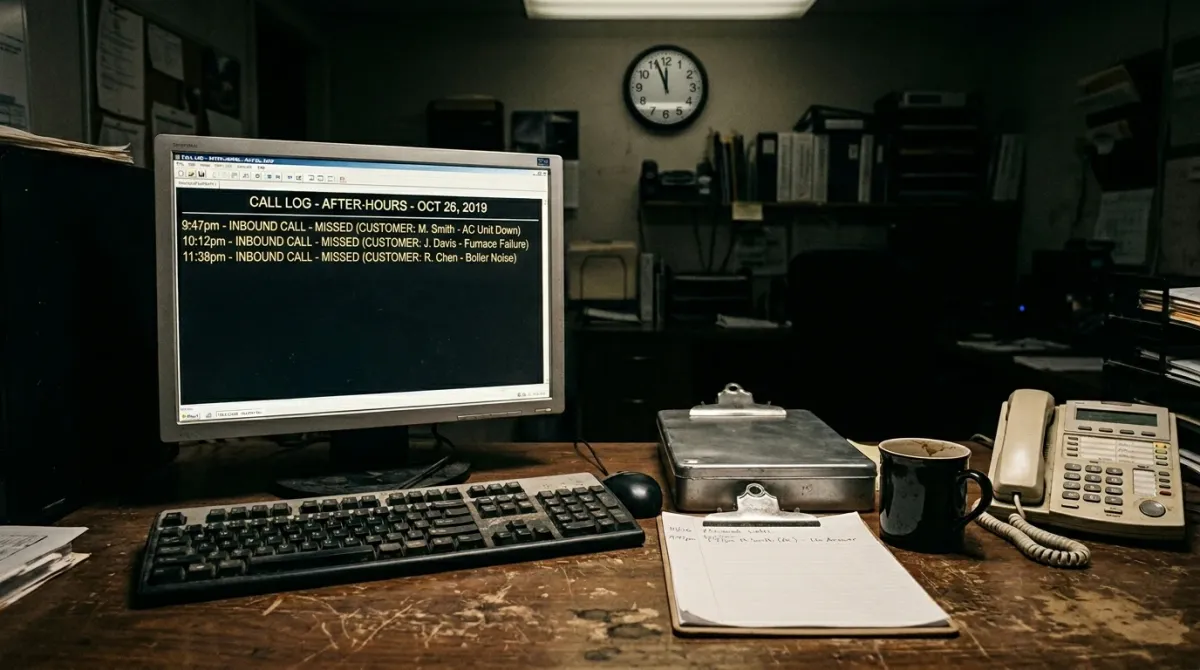
- After-hours coverage. A call at 9pm going to voicemail is a 15-25% recovery rate. The same call captured by AI with a callback scheduled for 8am the next morning is a 60-70% recovery rate. The math here is not close.
- Overflow when both lines are busy. Same logic. The alternative is voicemail or a busy signal.
- Weekends and holidays. Same logic. Either AI captures the call, or your competitor does.
- Single-truck operations with no CSR at all. AI is a meaningful upgrade over a personal cell phone going to voicemail when the owner is on a job.
- Seasonal call surge handling. August in Phoenix, January in Minneapolis. The capacity to answer every call during the surge matters more than the per-call quality during the moment of peak demand.
When AI Does Not Make Sense
- Replacing your only full-time CSR. The cost savings are real. The booking-rate exposure is larger than the savings, by an order of magnitude. You will not know the cost of the change until you have already paid it.
- Handling primary-hours replacement inquiry calls. These are the highest-value calls in HVAC. They require the most judgment, the most flexible objection handling, and the most ability to recognize a competitor shopper. AI is not there yet on this call type.
- As a substitute for fixing a broken CSR operation. A 42% booking rate is a training problem, not a technology problem. Replacing the CSR with AI does not fix the training problem. It hides it inside a system you cannot directly coach.
The Hybrid Model: How Most Operators Should Actually Deploy AI
For an HVAC operation between $1M and $15M in revenue, the deployment pattern that survives scrutiny is consistent:
- Live, trained CSR(s) handle primary business hours. Monday through Friday, 8am to 6pm. This is where 70-80% of your calls arrive and where booking-rate quality matters most.
- AI handles after-hours and weekends. Captures the call, qualifies emergency vs. non-emergency, schedules a callback in the morning for non-emergency, dispatches per your on-call protocol for emergency.
- AI handles overflow during business hours when both lines are busy. Same capture logic, same callback scheduling.
- The next morning, your CSR works the AI capture queue first. Every after-hours call gets a return call before 9am. Two-hour follow-up window is the recovery benchmark.
- Track AI capture rate, AI-to-callback conversion rate, and the booking rate on AI-captured calls separately. This is the data that does not exist publicly. You generating it for your own operation is the only way to know what AI is actually doing for your business.
That structure costs roughly $5,000/mo for the CSR and $300-$600/mo for the AI tier. The incremental revenue from after-hours and overflow capture typically pays back the AI cost in the first month.
This is not a sexy answer. It is the answer the math supports.
How to Decide for Your Operation
Five questions:
- What percent of your inbound calls currently go unanswered or to voicemail?
- What percent of your inbound calls arrive after 6pm or on weekends?
- What is your current CSR booking rate on answered primary-hours calls?
- What is your current follow-up rate on missed calls?
- Have you tested at least one AI receptionist on a small percentage of your call volume before committing?
If you cannot answer questions 1-4, the AI question is premature. Answer those first, then evaluate AI against a known baseline. The Call Answer Benchmarker and the Phone Revenue Calculator produce the baseline numbers.
Frequently Asked Questions
How much does an HVAC CSR actually cost per year?
A fully loaded full-time CSR in the United States runs roughly $58,000 to $65,000 per year. The base wage (BLS median: $19.96/hr, mean annual: $46,170) is only the starting point. Once employer payroll taxes, benefits, PTO, workers’ compensation, training, and equipment are added, total cost is 25 to 40 percent above base wage. Multi-CSR teams scale roughly linearly with modest shared-infrastructure savings.
How much does an AI answering service cost for an HVAC company?
AI receptionist pricing falls into four tiers as of April 2026. Self-serve small-business tools like Goodcall and Rosie run $50 to $150 per month. Mid-tier platforms with CRM integration and appointment booking run $150 to $400 per month. Premium AI-plus-human hybrid platforms like Smith.ai run $400 to $1,000+ per month. Phone-system bundles (Dialpad, RingCentral) add $15 to $30 per user per month. Pricing changes frequently; verify on each vendor’s site before purchasing.
Can AI receptionists replace a live CSR for an HVAC business?
For after-hours, weekend, and overflow coverage, yes — the math is clearly in AI’s favor versus voicemail. For primary-hours coverage, the available data does not yet support replacing a trained live CSR with AI. The booking-rate exposure (potentially 20 to 30 percentage points) is an order of magnitude larger than the cost savings. The hybrid model — live CSR primary hours, AI after-hours and overflow — is the deployment most HVAC operations should evaluate first.
What is the booking rate of AI receptionists vs. live CSRs in HVAC?
There is no neutral, independent, peer-reviewed study comparing AI booking rate to live CSR booking rate on HVAC calls. Vendor case studies report 40 to 60 percent on captured calls, but those numbers are self-selected and self-measured. By comparison, live CSR booking rates are well-benchmarked: 42% at the industry average, 62-70% in the top quartile. Until independent data exists, treat any AI booking-rate claim with skepticism.
Will an AI answering service hurt my booking rate?
It depends entirely on what you are comparing against and where you deploy it. AI versus voicemail: AI almost always wins. AI versus a poorly trained CSR: results are likely comparable. AI versus a top-quartile trained CSR on judgment-heavy calls: the trained CSR almost certainly wins, though the gap is narrowing. The honest answer is that you will not know what AI does to your specific booking rate until you measure it on your specific call volume.
Should an HVAC company use Goodcall, Rosie, Numa, Smith.ai, or another platform?
The platform name matters less than the deployment model. Pick a platform whose feature set covers (1) calendar integration with your dispatch system, (2) call recording and transcription so you can audit performance, and (3) a clear escalation path for emergency calls. Tier-2 platforms ($150-$400/month) cover most HVAC small-business needs. Tier-3 hybrid platforms ($400-$1,000) are worth the upgrade for higher call volumes or operations where call quality matters most.
How quickly can I deploy an AI answering service?
Most Tier-1 and Tier-2 AI platforms self-onboard in under a week — connect a phone number, configure call flows, integrate calendar, train on your service area and pricing logic. Tier-3 hybrid platforms typically require 2-4 weeks of setup including custom training and CRM integration. The longer-tail work is on your side: defining what counts as an emergency, what callback time windows you commit to, and how the morning CSR processes the AI capture queue.
Sources
- U.S. Bureau of Labor Statistics. Occupational Employment and Wage Statistics, May 2024 — Customer Service Representatives (43-4051). bls.gov/oes
- U.S. Bureau of Labor Statistics. Employer Costs for Employee Compensation news release — quarterly series on benefits and legally required contributions as a share of total compensation. bls.gov/ecec
- AI receptionist pricing tiers: Goodcall, Rosie, Numa, Slang.ai, Smith.ai, Dialpad, RingCentral — verified on respective vendor websites, late April 2026.
- Built on Tenth internal benchmark research on HVAC CSR booking rates and answer rates.
Built on Tenth is an independent HVAC market intelligence firm providing objective, data-backed diagnostic reporting for HVAC operators. We do not sell advertising, accept referral fees, or offer marketing agency retainers. Our loyalty is strictly to the data.