AUDITOR’S OVERVIEW
Net profit margin is the ultimate scoreboard for an HVAC operator, yet it is often the most misunderstood metric in the business. Most owners focus on “Gross Revenue” as the indicator of success, but revenue without a disciplined margin structure is simply a high-volume liability. As labor and material costs fluctuate in 2026, the gap between a 5% “survival” margin and a 20%+ “growth” margin depends entirely on pricing authority and overhead absorption.
THE BOTTOM LINE
HVAC is a 20% net profit business, not a 5% business. Our analysis of top-performing residential operations shows that achieving a 22% net margin requires a strict 50% gross margin floor on all service and replacement work. If your net profit is stagnant in the single digits despite rising revenue, you aren’t suffering from a lack of sales—you are suffering from a lack of pricing discipline.
This research dossier breaks down what healthy HVAC margins look like in measurable terms and provides the diagnostic levers needed to identify where your operational profit is being compressed.
The Three Margin Numbers You Need to Track Separately
Most HVAC owners who think about profitability track one number: whether their bank account went up or down. That is not enough to diagnose margin problems. You need three separate numbers.
Gross margin is revenue minus the direct cost of delivering your service, primarily labor, materials, and parts. For HVAC service work, healthy gross margins run in the 45% to 55% range. Installation and replacement work typically runs lower, in the 35% to 45% range, because of higher equipment cost relative to labor. If your blended gross margin is below 35%, your pricing or material costs are the starting point.
Operating margin is gross profit minus your overhead, which includes office staff, vehicles, rent, software, insurance, and marketing. This number tells you what the business earns from operations before accounting for owner compensation and taxes. A healthy HVAC operating margin is in the 15% to 25% range for well-run companies.
Net margin is what remains after everything: owner compensation, taxes, debt service, and any non-operating expenses. The industry average is 2% to 5%. The top quartile of HVAC operators runs 10% to 20%.
Tracking all three separately tells you where the leak is. A company with a 48% gross margin but a 4% net margin has an overhead problem, not a pricing problem. A company with a 28% gross margin cannot fix its profitability through overhead reduction alone. The pricing and job costing need attention first.
A well-run company at 14% net makes $308K. Revenue growth without margin discipline produces more work for less money. The difference is almost never found in a single category. It is usually a combination: tighter flat-rate pricing with fewer technician quote variations, a higher percentage of service work versus installation work, controlled overhead, and a marketing spend that is tracked to booked-job cost rather than lead count.
Margin by Service Type
Not all HVAC revenue is equally profitable. The margin profile varies significantly by work type.
Service and repair work carries the highest margin in most HVAC operations. The labor and diagnostic expertise is priced above commodity rates, parts markup is consistent, and there is no large equipment cost eating into the gross. Service work gross margins of 55% to 65% are achievable in well-priced operations.
Maintenance and tune-up agreements generate lower per-visit gross margin but produce recurring revenue that smooths cash flow across seasons. The real margin value of agreements comes through repeat business and the access to replacement opportunities they generate. The service agreements analysis covers how to quantify that revenue impact.
Replacement and installation work produces the largest absolute dollar amounts per job but the lowest gross margin percentage. Equipment cost on a $10,000 replacement might be $4,500 to $5,500, leaving $4,500 to $5,500 to cover labor, overhead, and profit. Gross margins in the 35% to 45% range are typical. Below 30% is a signal that equipment pricing or labor burden needs review.
Commercial work varies widely by contract structure. Time-and-materials commercial work often runs lower margin than residential service. Commercial maintenance contracts can be higher margin if priced correctly. Many residential HVAC companies that dabble in commercial work find that the commercial jobs run longer, require more overhead, and produce lower margin per dollar of revenue than their residential service work.
Is Your Growth Strategy Hiding a Net Profit Leak?
Audit your current gross margins and overhead recovery rates against the 2026 benchmarks for top-quartile HVAC firms.
AUDIT YOUR NET PROFIT →What Compresses HVAC Margins
Margin compression in HVAC almost always comes from one or more of four sources.
1. Technician quote inconsistency. When techs quote the same repair at different prices depending on what the customer seems willing to pay, or simply from memory rather than a price book, the variation almost always skews low. An owner who audited technician quotes found the same job quoted at $340, $290, and $410 across three different techs. Two of those three quotes were leaving money on the table. Flat-rate pricing with a consistent book eliminates this variance.
2. Overhead that grew with revenue but not with profit. The most common overhead trap in HVAC is adding staff and trucks during strong revenue years without tracking whether those additions are margin-accretive. A company that adds a truck when revenue hits $2M but margins do not support the operating cost of that truck is growing its overhead faster than its profit.
3. Marketing spend without booked-job tracking. HVAC companies that pay for leads without knowing their cost per booked job frequently overspend in marketing categories that generate volume but not quality. Spending $15,000 per month on marketing that produces 120 leads but only 40 booked jobs at $350 average ticket is $15,000 generating $14,000 in revenue. That arithmetic does not work.
4. Market pricing pressure. In some local markets, there are competitors willing to win jobs at prices that compress the margin available to everyone. If your local market has several aggressive low-price operators dominating the map pack, their pricing behavior affects your ability to hold margin on replacement and service work.
What the Top Operators Do Differently
HVAC companies consistently achieving 12% to 20% net margins share a few behaviors that lower-margin companies typically do not have.
They track margin by service type, not just total revenue. They know whether their service work margin is higher than their installation margin and they manage mix accordingly.
They have a price book that every tech uses. Not a rough estimate from memory. A structured, reviewed, updated price book that produces consistent quotes.
They know their cost per booked job by channel. They spend marketing dollars where the economics work and cut where they do not.
They have a service agreement program with real attach rates. Recurring revenue smooths overhead across slow seasons and reduces the fixed-cost pressure that compresses margin during off-peak months.
They know their overhead cost per billable hour. If your total monthly overhead is $80,000 and you produce 800 billable hours per month, your overhead cost per billable hour is $100. That number needs to be built into every pricing decision.
How to Diagnose Your Margin Problem
Start with gross margin by service type. If your gross margin is healthy (45%+ on service, 38%+ on installation), the problem is overhead or below-the-line costs. Work from there.
If gross margin is low, pricing and direct costs are the issue. Flat-rate pricing discipline is almost always the first fix.
If gross margin is healthy and overhead is reasonable but net margin is still thin, look at owner compensation structure, debt service on equipment, and whether your revenue mix is weighted toward lower-margin work types.
And if you suspect that your local market’s competitive dynamics are affecting your ability to hold price and maintain margin, that is the piece that external data can answer.
Frequently Asked Questions
What is a good HVAC profit margin?
The industry average net margin is 2% to 5%. Well-run HVAC companies achieve 10% to 20% net margin. The difference is usually a combination of flat-rate pricing discipline, overhead management, marketing efficiency, and a higher proportion of service versus installation revenue.
What is the difference between gross margin and net margin in HVAC?
Gross margin is revenue minus direct job costs (labor, materials, parts). Net margin is what remains after subtracting all overhead, owner compensation, taxes, and other expenses. A company can have a 48% gross margin and a 5% net margin if overhead is high.
How does HVAC service mix affect profitability?
Service and repair work typically generates gross margins of 55% to 65%. Replacement and installation work runs 35% to 45% because of higher equipment costs. A company with a higher percentage of service revenue relative to installation revenue will generally have better gross margins, even at lower total revenue.
Is it possible to have too high a close rate?
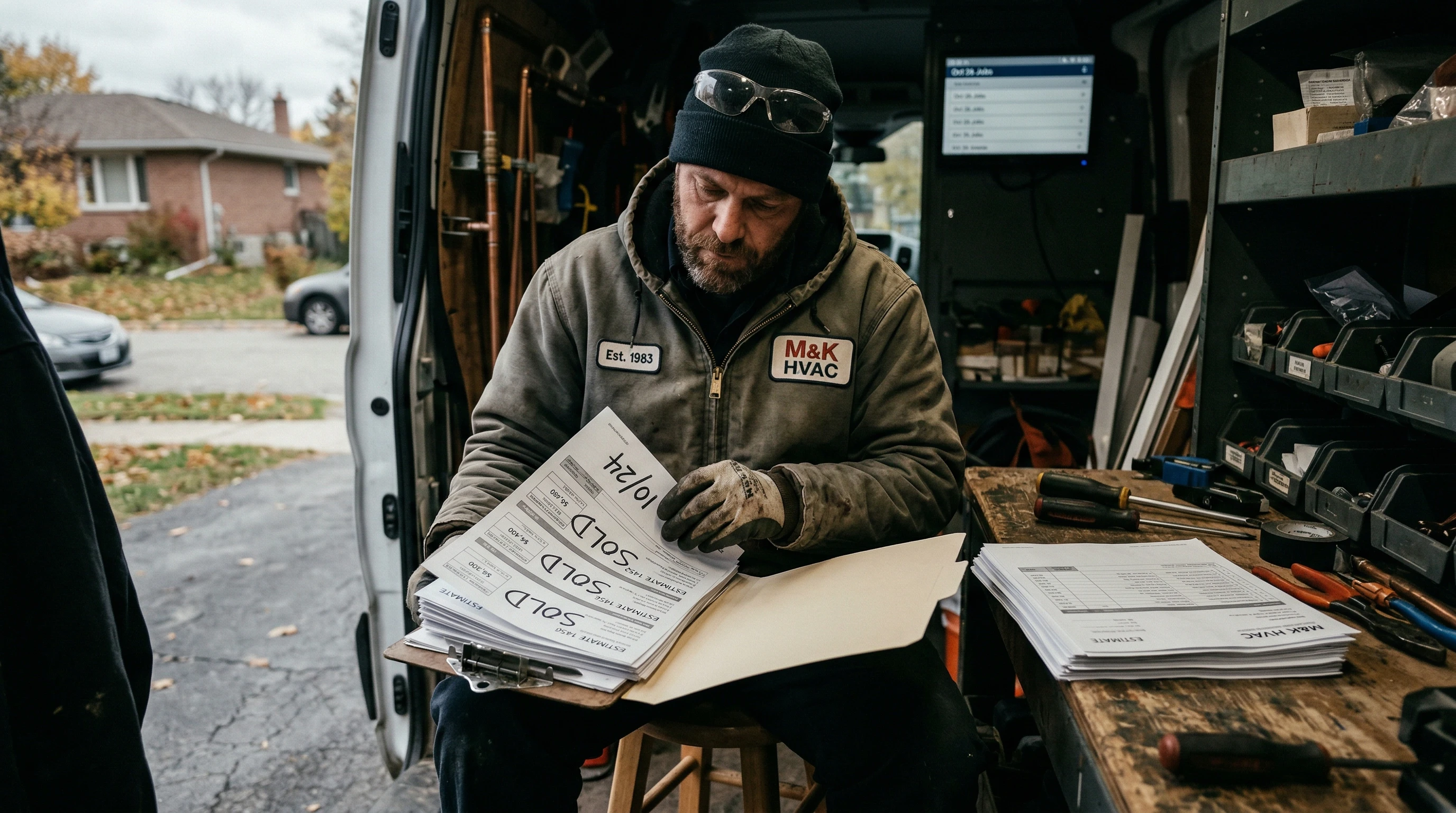
Yes. A consistent close rate above 70% to 75% across all call types is often a signal that pricing is too low. If you are closing nearly every estimate, you are rarely losing on price, which means your pricing may have room to move up without meaningfully reducing volume.
How should I think about overhead cost per billable hour?
Divide your total monthly overhead by your total monthly billable hours. The result is your overhead cost per billable hour. That number should be built into your flat-rate pricing so that every job covers its share of overhead before contributing to profit. Most HVAC owners who run this calculation for the first time find they have been underpricing to overhead.
Built on Tenth is an independent HVAC market intelligence firm providing objective, data-backed diagnostic reporting for HVAC operators. We do not sell advertising, accept referral fees, or offer marketing agency retainers. Our loyalty is strictly to the data.