AUDITOR’S OVERVIEW
The Customer Service Representative (CSR) is the most undervalued revenue driver in the HVAC business. For many owners, the CSR role is viewed as an administrative function, but in reality, it is the filter that determines the ROI of every marketing dollar spent. A weak CSR operation doesn’t just provide “bad service”; it actively liquidates your marketing budget by failing to convert high-intent calls into booked appointments.
THE BOTTOM LINE
Booking rate is the ultimate multiplier of ad spend. Our analysis of top-performing HVAC operations shows that moving a CSR team from a 42% to a 65% booking rate can recover over $300,000 in “hidden” annual revenue from the same call volume. If your team treats every call like an inquiry rather than a transaction, you are likely discarding 4 out of every 10 leads you’ve already paid for.
This research dossier maps the performance benchmarks for modern CSR teams and provides the framework to diagnose where your phone handling logic is failing to capture the demand your marketing has already paid for.
At average performance: 300 calls x 68% answer rate x 42% booking rate = 86 booked jobs. At $1,800 average ticket: $154,800 per month.
At top-quartile performance: 300 calls x 89% answer rate x 65% booking rate = 173 booked jobs. At $1,800 average ticket: $311,400 per month.
That $156,600 monthly gap is not generated by more leads, more trucks, or more marketing spend. It comes from handling the calls that are already arriving more effectively.
The Benchmark Table
These ranges reflect what HVAC companies at different performance levels actually produce. Use them to locate where your operation sits, not as a ceiling.
| Metric | Below Average | Industry Average | Strong | Top Quartile |
|---|---|---|---|---|
| Answer rate | Below 60% | 68% | 80-88% | 91%+ |
| Booking rate (all calls) | Below 35% | 42% | 52-58% | 62-70% |
| Follow-up rate on unbooked calls | Below 10% | Under 20% | 50%+ | 80%+ |
A company below 60% answer rate is losing calls before a CSR ever engages. A company at 42% booking rate on answered calls is converting fewer than half of the calls that do get through. Both problems compound. Both are fixable without changing a single marketing channel.
Booking Rate Is Not One Number
The most important refinement most HVAC owners miss: booking rate is not a single metric. It varies significantly by call type, and tracking only a blended rate hides where the real problem is.
Emergency repair calls: These should book at 70% or above. The homeowner has an immediate problem and limited patience to call around. A booking rate below 65% on emergency calls usually signals a pricing communication problem or a slow answer response rather than a genuine CSR performance failure.
Maintenance and tune-up calls: Homeowners calling to schedule a routine service are already in a buying mindset. Booking rates of 80% or better are achievable on this call type. Failures here are almost always a scheduling friction issue: no available slots, awkward booking process, or a CSR who is not confidently offering times.
Replacement inquiry calls: These are the calls where the homeowner is exploring options and may be calling multiple companies. Booking rate on replacement inquiry calls runs lower, typically 40% to 55% even at well-run operations. The job is to get them to the estimate stage, not to close on the phone.
Inbound leads from paid channels: Paid search and LSA leads often have higher intent than organic calls, but they are also more likely to be shopping. A booking rate of 55% to 65% on paid channel inbound calls is a strong performance benchmark.
When you track all of these as one blended number, a high emergency booking rate can hide a failing replacement inquiry booking rate. Break them apart.
The 3 Failures That Cost the Most
Failure 1: Nobody Tracks Answer Rate
Most HVAC owners have a general sense of whether their phones are busy. When call tracking data is actually pulled, the gap between perception and reality is almost always significant. Owners who believe they are answering 85% of calls are frequently running at 62 to 68%.
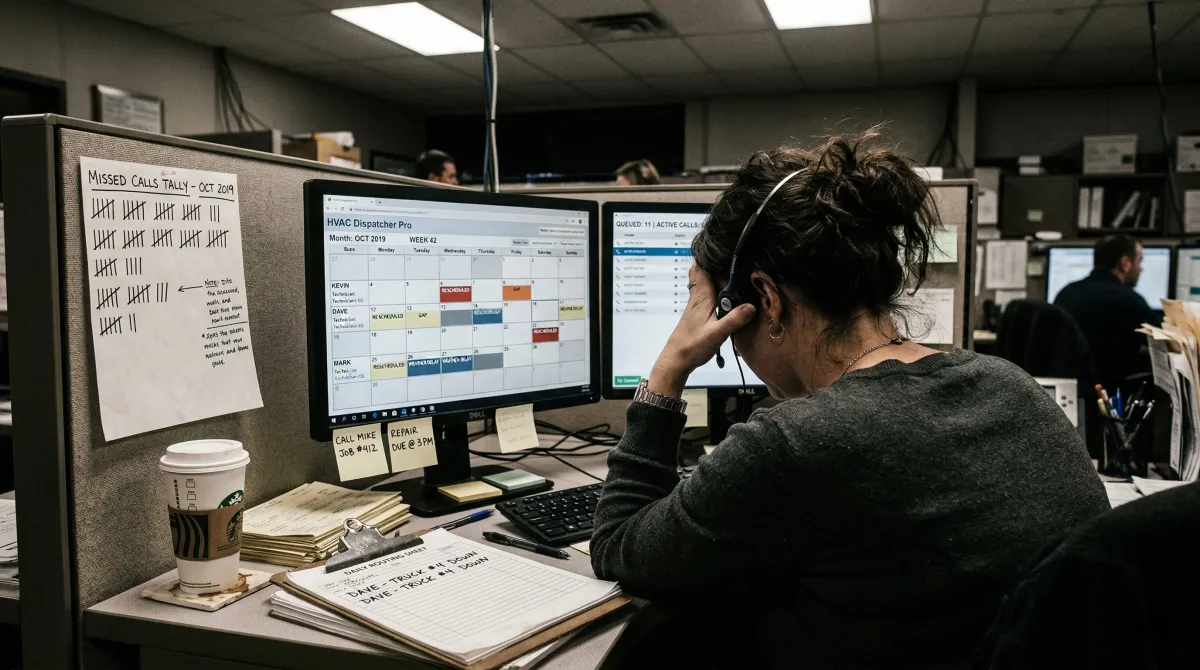
The missed calls happen in the cracks: the call that arrived during a tech escalation, the afternoon rush when both lines were occupied, the Saturday morning overlap. Each missed call at a $1,800 average ticket represents roughly $1,260 in potential lost revenue at a 70% booking and close rate. At 300 calls per month with 32% missed, that is 96 missed calls and over $120,000 in potential monthly revenue lost before a CSR ever picks up.
Top performers treat answer rate as an operational metric that lives on a visible dashboard. When it drops below 88%, there is a conversation the next day.
Failure 2: CSRs Are Taking Orders, Not Booking Jobs
A CSR who answers professionally, answers every question politely, and says “sure, no problem, give us a call when you are ready” is not performing a bad job. They are performing an undertrained one.
The gap between a 42% and a 62% booking rate almost always comes down to a single missing behavior: the booking ask. The CSR who gives the homeowner all the information they need and then waits for the homeowner to commit is leaving the decision entirely in the homeowner’s hands. The CSR who transitions directly from answering a question to offering a specific time slot is guiding the homeowner to a decision they were already leaning toward.
The difference in language is small. “We have availability tomorrow morning or Thursday afternoon, which works better for you?” versus “Sure, just give us a call when you are ready.” One of those sentences produces a booked job. The other produces a pending inquiry that closes at 15%.
Failure 3: No Follow-Up System on Unbooked Calls
A caller who does not book on the first contact is not a lost lead. They are a pending one. In most HVAC companies, unbooked calls are never followed up. The homeowner said they would call back. They did not. The call is written off. An unbooked call followed up within two hours recovers a meaningful percentage of those conversations. An unbooked call followed up the next afternoon recovers far fewer, because the homeowner has already found an alternative.
Is Your CSR Desk Liquidating Your Marketing ROI?
Audit your current CSR booking rate and identify the exact revenue leakage from unbooked inbound calls.
BENCHMARK YOUR PHONES →BOOKING RATE BY INDIVIDUAL CSR
The most diagnostic analysis in HVAC phone performance is not your company-wide booking rate. It is the spread across your individual CSRs.
If your company-wide booking rate is 44%, that number might reflect one CSR at 62%, two between 45% and 50%, and one at 28%. The 62% CSR is demonstrating that the booking rate is achievable at your call volume and call type mix. The 28% CSR is either missing the booking ask on a large percentage of calls or handling specific objections in ways that consistently lose the caller.
A 35-point spread between your top and bottom CSR means your bottom performer is generating booked jobs at roughly double the cost of your best one. Five recorded calls from the bottom performer will almost always reveal the same two or three patterns: a specific moment where the call loses direction, a hesitation on pricing questions, or a missed booking transition after an objection.
That is a training target, not a termination signal. Most CSRs with a low booking rate are not incapable. They were never trained on the specific behavior that moves the call toward a scheduled appointment.
What the Revenue Per Call Math Tells You
The core calculation is useful here: at a 68% answer rate, 42% booking rate, and $1,800 average ticket, the expected revenue per inbound call received is roughly $104.
At 89% answer rate and 62% booking rate with the same average ticket: $202 per inbound call.
That difference means every call arriving at your business is worth either $104 or $202 depending on how your phones are managed. Marketing spend that generates 100 calls per month is producing either $10,400 or $20,200 in expected revenue from the same budget, depending on your phone operation.
This is why fixing phone performance produces a compound return on every other channel investment. Better SEO sends more traffic. More LSA leads arrive. More Google Ads clicks land. If the phone operation is leaking, all of those channels underperform proportionally.
The Answering Service Decision
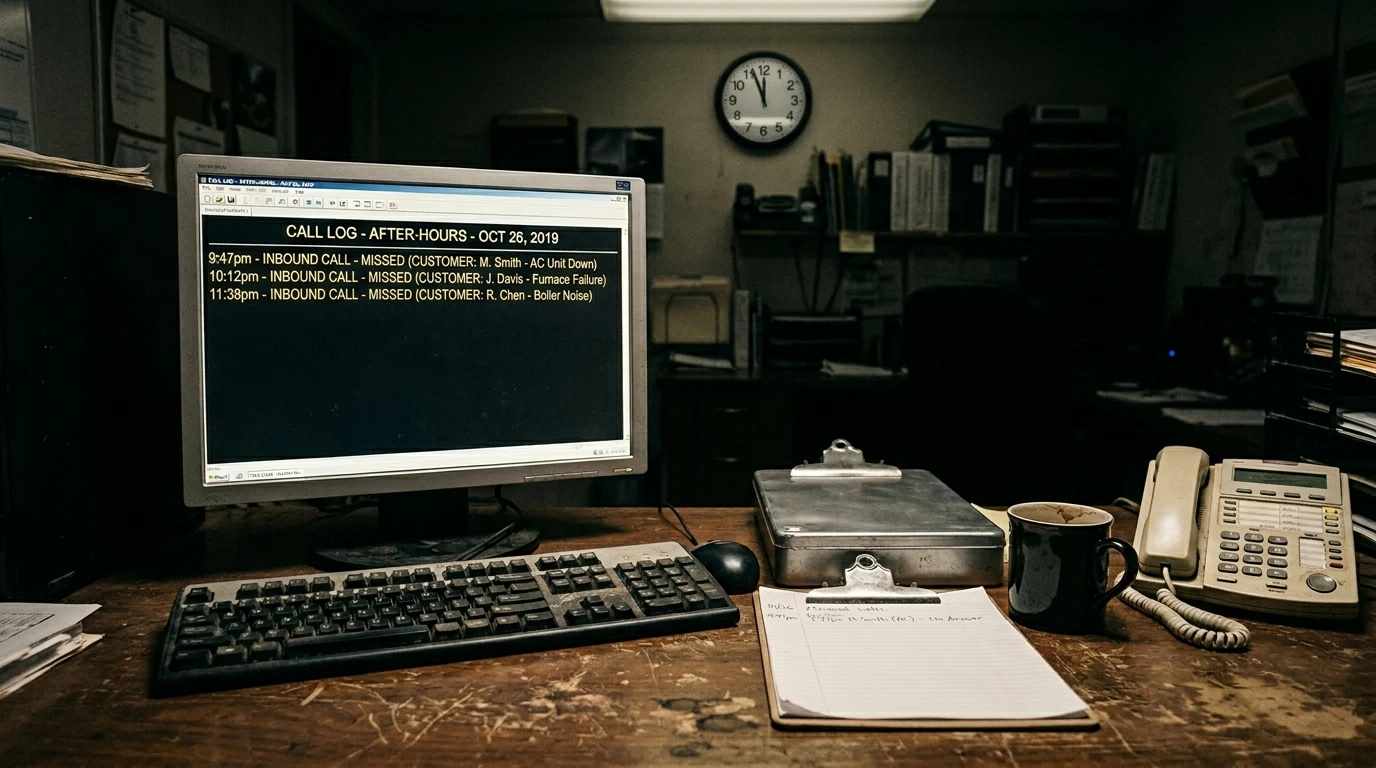
For HVAC companies that cannot staff live phone coverage during all business hours, an answering service is worth evaluating. The economics are clear enough for after-hours coverage: emergency calls at 9pm arriving at voicemail are lost. An answering service that captures the caller’s information and preferred callback time recovers a portion of those callers.
The tradeoff: generic answering services with no HVAC-specific training produce low booking rates on anything above basic message-taking. HVAC-specific answering services with trained agents and booking system access work significantly better, but cost $300 to $800 per month depending on volume.
All after-hours contact information reviewed by the in-house CSR the next morning with same-day follow-up calls.
How to Know If You Have This Problem Right Now
Six questions that take two minutes:
- Do you know your answer rate for last month?
- Do you know your booking rate by call type?
- Does every CSR ask for the appointment on every call?
- Do unbooked calls get followed up within two hours?
- Do you track booking rate by individual CSR separately?
- Is your after-hours call coverage staffed or going to voicemail?
Three or more no answers means you have a phone performance problem. The good news is that it is the most recoverable revenue leak in most HVAC operations. No additional marketing spend required.
Frequently Asked Questions
What is a good booking rate for an HVAC company?
Top-performing HVAC operations book 62 to 70% of answered calls. The industry average is 42%. Below 40% is a signal that training is needed. A more useful question is booking rate by call type: emergency calls should book at 70% or above, maintenance calls at 80%+, and replacement inquiry calls at 40% to 55%.
What is the difference between answer rate and booking rate?
Answer rate is the percentage of incoming calls picked up before voicemail. Booking rate is the percentage of answered calls that result in a scheduled appointment. Both are separate problems with separate fixes. High answer rate with low booking rate means calls are being taken but not converted. Low answer rate with high booking rate means the conversion is strong but too many calls never reach the CSR.
How do I calculate what missed calls are costing me?
Multiply your monthly missed calls by your average ticket by your booking and close rate. Example: 80 missed calls x $1,800 average ticket x 65% combined booking and close rate = $93,600 per month in expected lost revenue. The Phone Revenue Calculator runs a detailed version with your specific numbers.
How quickly should an HVAC company follow up on unbooked calls?
Within two hours for a callback, within four hours for a text if no answer. Research on home service purchase behavior consistently shows that the business that reaches back first wins the majority of undecided callers. Waiting until the next business day means most of those callers have already committed elsewhere.
How do I train my HVAC CSR to book more calls?
Start with the booking transition. Write one sentence that moves from answering a question to offering a time slot: “Are mornings or afternoons better for you this week?” Practice it until it sounds natural on every call type. Then review five recorded calls per week from each CSR and identify the specific moment where unbooked calls break down. Most CSRs have one or two recurring patterns that account for most of their booking failures. Fixing those specific patterns moves the number faster than general training.
What is a good HVAC phone answer rate?
Top-quartile HVAC companies answer 91% or more of inbound calls. The industry average is 68%. Below 80%, fixing answer rate is almost always a higher-ROI move than adding marketing spend, because every channel’s cost per booked job improves automatically when more calls get answered.
What is a realistic timeline to improve CSR booking rate?
With deliberate script training, weekly call review, and individual tracking, most CSRs improve booking rate by 8 to 15 percentage points within 60 days. The improvement is fastest when the gap is a specific trainable skill and slowest when it is a general confidence or communication issue. Adding individual-level tracking alongside training accelerates improvement because CSRs can see their own number moving in real time.
Built on Tenth is an independent HVAC market intelligence firm providing objective, data-backed diagnostic reporting for HVAC operators. We do not sell advertising, accept referral fees, or offer marketing agency retainers. Our loyalty is strictly to the data.