Most HVAC companies have a service agreement program on paper. The gap is in attach rate: how often technicians are actually presenting and closing agreements on eligible calls, versus how often they complete the job and leave without raising the topic.
A well-run agreement program attaches on 30% to 50% of eligible calls. Most HVAC companies are operating significantly below that floor.
This piece covers what attach rate benchmarks look like in practice, how to break them down by technician and call type, and how agreement sales connect to the revenue per truck metrics that most owners care about.
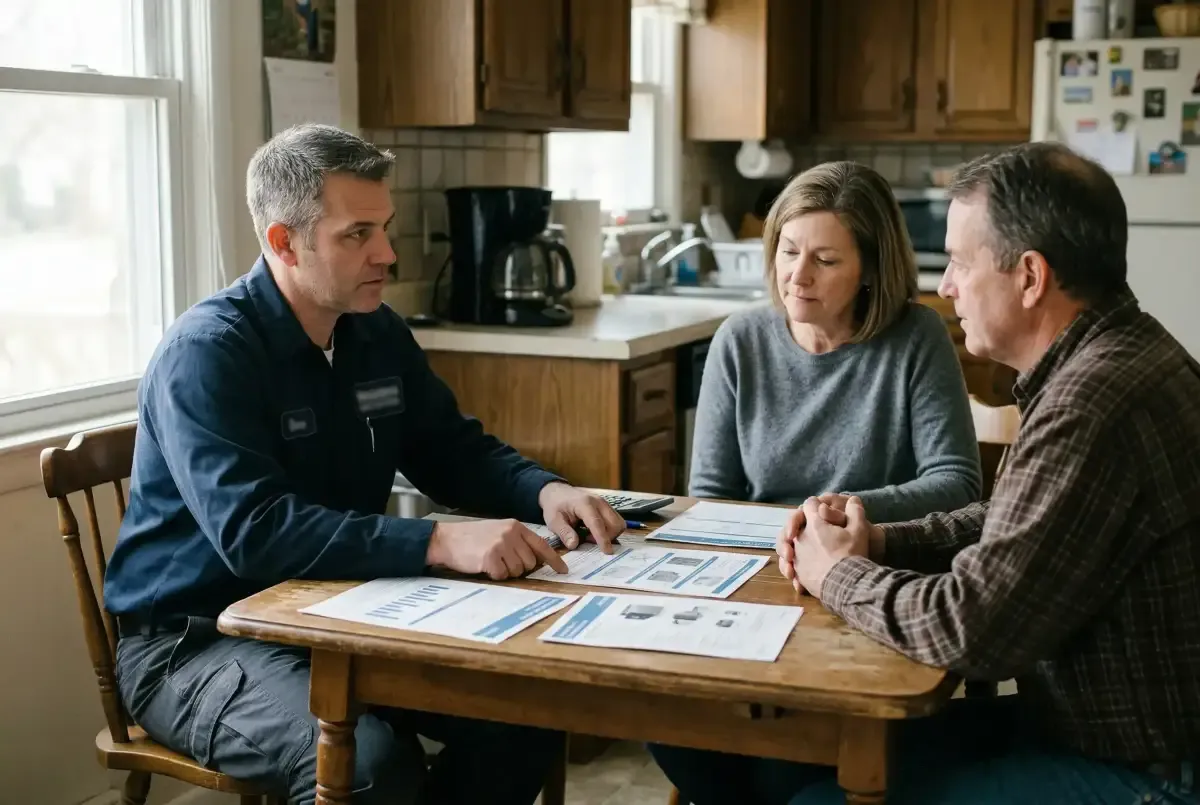
[Image placeholder: HVAC technician reviewing a maintenance agreement brochure with a homeowner after completing a service call at a residential property]
What a Functioning Attach Rate Actually Looks Like
An attach rate is not just an agreement sales rate. It is a measure of how consistently your technicians are identifying eligible customers, having the conversation, and closing the agreement before leaving the job site.
The math for a company doing 400 service calls per month with 60% being agreement-eligible calls:
240 eligible calls per month.
At a 20% attach rate: 48 new agreements per month.
At a 40% attach rate: 96 new agreements per month.
At typical residential plan pricing of $200 to $350 per year, the difference between a 20% and 40% attach rate on that volume is $9,600 to $16,800 in additional recurring revenue per month. Over a year, that gap is $115,200 to $201,600 in agreement revenue.
That is before accounting for what agreement customers spend on repairs and replacements versus non-agreement customers. Research consistently shows that service agreement customers have two to three times the lifetime value of one-time service customers.
The service agreements analysis covers the full revenue model in detail, including how agreements stabilize slow-season call volume and improve business valuation multiples.
Attach Rate Ranges by Program Maturity
These benchmarks reflect what HVAC companies at different stages of agreement program development typically see.
New or inconsistent programs (0-15% attach rate): The program exists but techs are not presenting it consistently. Agreement sales happen when individual techs feel like bringing it up, not as a standard part of every eligible call. There is no tracking by technician.
Developing programs (15-30% attach rate): Techs are presenting agreements on most eligible calls. The conversation is happening, but closing rate varies significantly by tech. Some techs close 40% of their agreement conversations. Others close 10%. Management is tracking total agreement count but not attach rate by individual technician.
Strong programs (30-50% attach rate): Agreements are presented on every eligible call as a standard step in the service completion process. Individual tech performance is tracked. Techs who underperform relative to peers are coached specifically on the agreement conversation. New agreements and renewals are both tracked separately.
Elite programs (50%+ attach rate): Agreement sales are embedded in the company culture and compensation structure. Techs who sell agreements earn a meaningful per-agreement bonus. Agreement count is tracked daily, not just monthly. Renewal rates are actively managed. These programs typically run at companies where agreements represent 15% to 25% of total annual revenue.
How to Break Attach Rate Down by Technician
The most useful analysis is not your company-wide attach rate. It is the range across your individual technicians.
If your company-wide attach rate is 22%, that number might reflect one tech at 48%, three techs between 25% and 35%, and two techs below 10%. The 48% tech is demonstrating that the conversation can be had and closed successfully at that call volume. The sub-10% techs are either not having the conversation or handling it in a way that consistently gets rejected.
Tracking attach rate by technician gives you two things: a realistic ceiling based on what your best tech is already demonstrating is achievable, and a coaching target for techs who are below that ceiling.
The conversation between a 48% tech and a 10% tech, when facilitated by a manager who has looked at the data, is often where the fastest attach rate improvement comes from. The 10% tech is not incapable. They are usually either skipping the conversation on calls where they do not expect interest, or presenting it in a way that prompts easy rejection.
Attach Rate by Call Type
Not all calls are equally eligible for agreement sales, and attach rates differ significantly by what brought the homeowner to call in the first place.
Maintenance and tune-up calls: These are the most natural agreement sale moment. The homeowner is already in a maintenance mindset. The tech is completing a service visit. Transitioning from “here is what we did today” to “here is how to stay on this schedule year-round” is a short conversational step. Attach rates on tune-up calls at strong programs often run 45% to 65%.
Emergency repair calls: The homeowner is stressed, often a little frustrated, and sometimes already angry about the timing of the problem. Presenting an agreement immediately after diagnosing a failed part is sometimes the right moment and sometimes exactly wrong. The best techs read the room. If the repair resolved the problem cleanly and the homeowner is visibly relieved, the agreement conversation can happen. If the homeowner is still upset about the cost or the inconvenience, it should wait. Attach rates on emergency calls run lower on average, typically 15% to 30% at strong programs.
Replacement and installation calls: A homeowner who just purchased a new system is a natural agreement prospect. They have demonstrated willingness to spend on HVAC. The new equipment creates a natural “protect this investment” framing. Attach rates on replacement calls should be among the highest in any program, yet many companies fail to have the conversation at all because the tech is focused on the installation completion. Strong programs run 40% to 55% attach on replacement calls.
First-time service calls from non-customers: These are lower-probability agreement moments. The homeowner does not yet have a relationship with your company. Trust is not established. The attach rate on first calls is typically lower, and the priority should be delivering an excellent service experience that earns the follow-up conversation, either on that call if it goes well or on the next call.
[Image placeholder: Simple bar chart showing agreement attach rate by call type: tune-up, emergency repair, replacement, first-time service call]
The Connection Between Attach Rate and Revenue Per Truck
A technician who consistently closes agreements on 40% of eligible calls is doing two things simultaneously: generating immediate agreement revenue and building a book of business that fills future dispatch slots.
Agreement customers call their HVAC company first when something goes wrong. They are already paid up. They are lower-friction bookings than cold calls. Over time, a tech with a strong agreement book produces more revenue per truck than an equally skilled tech without one, because the agreement customers provide a baseline of non-competitive, pre-committed work.
The HVAC Revenue Per Truck Benchmark shows how agreement program depth is one of the factors that separates top-quartile revenue per truck from average. The dispatch efficiency piece shows how agreement customers smooth out the routing variability that costs non-agreement techs billable time.
Attach Rate and Slow Season Economics
One of the underappreciated benefits of a strong agreement program is what it does to your slow season.
An HVAC company with 500 active maintenance agreements generates 500 tune-up calls per year just from agreement fulfillment. Those calls do not depend on weather urgency, marketing spend, or inbound lead volume. They are pre-committed appointments.
If you run a two-visit agreement (one cooling check, one heating check), 500 agreements generate 1,000 scheduled visits per year. Distributed across 12 months, that is roughly 83 visits per month from agreement customers alone. In a slow month where inbound call volume drops by 40%, those 83 visits provide a revenue and dispatch floor that non-agreement companies simply do not have.
This is why strong agreement programs consistently show up in the financial profiles of HVAC companies with higher business valuations. Recurring revenue that does not depend on seasonality or marketing is worth more per dollar than transactional revenue.
Where Agreement Conversations Fail Most Often
Three patterns produce most of the attach rate underperformance in HVAC companies.
Pattern 1: Techs skip the conversation on calls where they do not expect interest. This is the most common failure. The tech decides the homeowner seems price-sensitive, or the job took longer than expected, or they are already running late, and they skip the agreement conversation. The result is a near-zero attach rate on a meaningful percentage of calls. Every eligible call should get the conversation, even in abbreviated form.
Pattern 2: The conversation starts with price. “We have a maintenance agreement for $189 per year” is a price introduction, not a value introduction. A homeowner who hears the price first makes a budget decision before understanding what they are buying. The conversation that closes agreements starts with what the homeowner gets: priority scheduling, two visits per year, parts discounts, lower emergency rates. Price comes after the value is established.
Pattern 3: No follow-up on declined agreements. A homeowner who declines an agreement today, because of timing or uncertainty, may be receptive six months later. Companies that track declined agreements and include them in follow-up outreach recover a percentage of that deferred revenue. Most companies track signed agreements only and do not revisit declined ones.
Frequently Asked Questions
What is a good HVAC maintenance agreement attach rate?
Strong programs achieve 30% to 50% of eligible calls resulting in a new agreement. Elite programs run above 50%. Most HVAC companies with inconsistent programs are operating below 20%. The most useful benchmark is not industry average but your own best technician’s attach rate, which shows what is actually achievable in your operation.
How should I track attach rate by technician?
In your field service software, tag agreement sales by technician at the time of close. Calculate each tech’s attach rate by dividing their agreement sales by their eligible call count for the same period. This requires consistently tagging eligible calls as a call type. Run this report monthly and use it in one-on-one tech conversations.
Which call types produce the best agreement attach rates?
Maintenance and tune-up calls typically have the highest natural attach rate (45% to 65% at strong programs). Replacement and installation calls should also produce high attach rates but often do not because techs are focused on installation completion. Emergency repair calls produce lower rates because of customer stress, but still warrant the conversation when the service experience was positive.
Do maintenance agreements improve business valuation?
Yes. Recurring revenue streams with renewal rates above 70% are valued at higher multiples than transactional revenue in HVAC business sales. A company with $300,000 in active agreement revenue is worth more than a company with the same total revenue but no recurring component.
How do I improve a tech with a low attach rate?
Start with data. Show them their attach rate versus their peers. Ask them to walk you through their typical end-of-call conversation. The fix is almost always in the conversation structure: either they are skipping the conversation entirely on some calls, or they are leading with price instead of value. Role-playing the conversation in a brief training context, based on what your highest-attaching tech actually says, produces faster improvement than generic training materials.