AUDITOR’S OVERVIEW
If you are running Google Ads for your HVAC company and not running Local Service Ads (LSAs), you are paying to appear below the contractors who are. LSAs sit at the very top of Google search results, above regular paid ads and the map pack, capturing 30% to 45% of total clicks on the entire results page. For most operators, the barrier to entry is not the cost, but the bureaucratic friction of the verification process.
THE BOTTOM LINE
LSA dominance is determined by response speed and review velocity, not just bid amount. If your CSR team isn’t answering LSA calls within 15 seconds or your technicians aren’t systematically requesting Google reviews, your profile will be downgraded by the algorithm regardless of your budget. A properly managed LSA account should produce booked jobs at 30–40% lower cost than traditional search ads.
This research dossier breaks down the full 2026 setup process, the ranking factors most companies miss, and how to verify if your LSA leads are actually converting into invoices.
What LSAs Are (and What They Are Not)
What they are: Local Service Ads are a Google product where you pay per lead, not per click. A lead is a call or message from a homeowner who found your LSA listing. Google shows your ad when someone searches for a service you offer in your area. You set a weekly budget. Google controls how often you appear within that budget based on your ranking signals.
The Google Guaranteed badge signals to homeowners that Google has verified your license, insurance, and background check. It is a trust signal no regular ad or organic listing carries.
What they are not: LSAs are not Google Ads. They run on a completely separate platform with separate billing, separate setup, and a separate ranking algorithm. Running Google Ads does not give you LSA placement. You have to set them up independently.
LSAs are also not a set-it-and-forget-it system. How you respond to leads, how you dispute bad leads, and how you manage your review profile all affect how often Google shows your ad. The mechanics are covered below.
The Verification Process: What to Expect
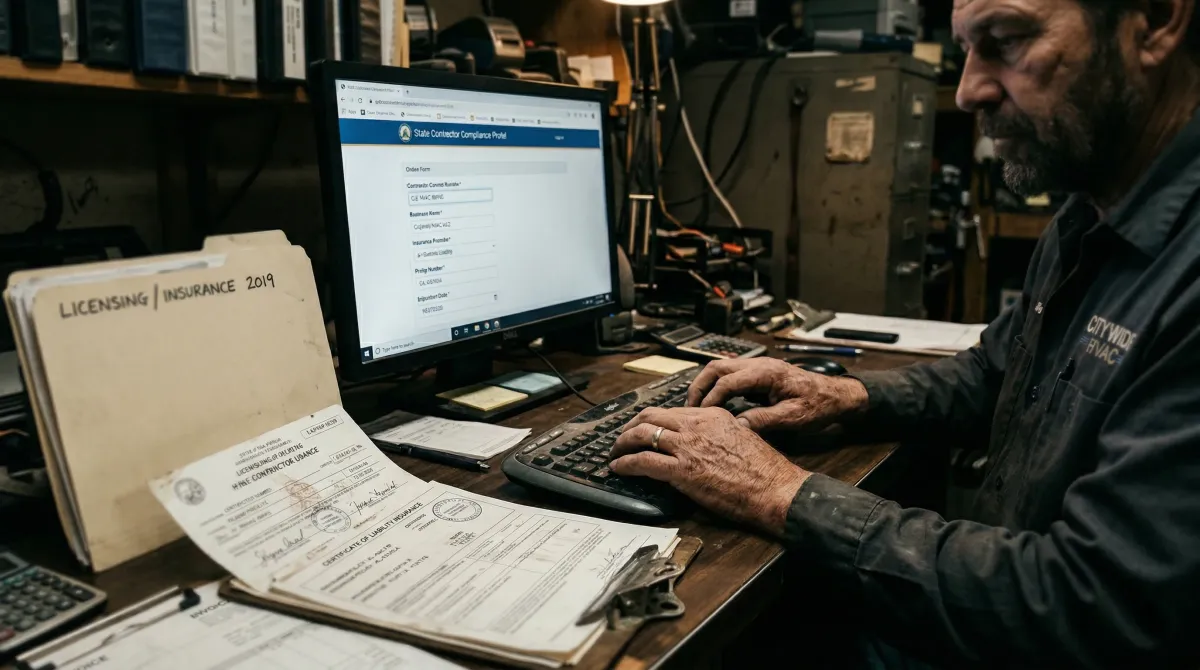
This is where most HVAC companies stall. The verification process is real work. It is also a one-time investment that creates a durable competitive advantage because many competitors never finish it.
What you need:
- A verified, active Google Business Profile
- A valid business license for the states you operate in
- Proof of general liability insurance (certificate of insurance)
- Background check completion for the business owner and any named technicians
How the process works:
Go to ads.google.com/local-services-ads to start. Create your profile, select HVAC as your service category, and enter your service area. Upload your license and insurance documents. Google initiates a background check through a third-party provider, typically Evident or similar. The business owner submits a consent form.
Realistic timeline: Document review runs 3 to 7 business days. Background check runs 5 to 10 business days. Total: 2 to 4 weeks in most cases. Peak periods in spring and fall extend this as verification queues grow.
The most common delay: Mismatched business information. If your license reads “Johnson HVAC LLC” and your GBP reads “Johnson Heating and Cooling,” Google flags the discrepancy. Match your GBP name, license, and insurance certificate exactly before submitting. That one step prevents most verification holds.
Setting Up Your Profile for Maximum Visibility
Once verified, your setup decisions directly affect how often Google shows your ad and at what position.
Service categories: Select every service you actually perform, not just your primary one. AC repair, furnace repair, HVAC installation, duct cleaning, thermostat installation. Each category triggers your ad for different search terms. Companies that select only “HVAC” miss searches for “furnace tune-up” or “AC maintenance” that would have triggered their listing.
Do not select services you cannot staff. Google penalizes dispute rates. If you receive a lead for duct cleaning and do not offer it, you dispute the lead, and high dispute rates hurt your ranking.
Service area: Enter the zip codes where you actually complete work. Avoid the temptation to set a radius so large that you cannot service the edges realistically. Leads from zip codes you cannot staff generate low contact rates, which damage ranking.
Hours: Set your listed hours to match your staffed phone coverage. Google tracks response rate as a primary ranking signal. If leads arrive at 8pm and you are not answering, that gap suppresses your ranking over time. Your listed hours should reflect when someone will actually answer the phone, not when you would ideally want calls.
Budget: Start with a budget that allows 5 to 7 leads per week. Below that, Google does not have enough activity data to optimize your placement. A starting weekly budget of $300 to $500 for most mid-size HVAC markets is reasonable. Adjust up or down after 30 days based on your cost per booked job.
How Google Ranks LSAs: What Actually Moves Your Position
Unlike Google Ads where you can buy position with a higher bid, LSA ranking is earned through operational signals. This makes it harder to game and harder to displace once you have built position.
Review count and rating: Your GBP reviews feed directly into your LSA profile. The review count and star rating shown on your LSA listing are your GBP numbers. Companies with more reviews and higher ratings consistently outrank those with fewer and lower, all else being equal. This is why building review velocity before launching LSAs improves your ranking from day one.
Response rate: Google tracks the percentage of leads you contact within a defined window. A response rate below Google’s threshold reduces your ad frequency before you notice the pattern. Leads that arrive during your listed hours that go unanswered are the most damaging to this signal.
Dispute rate: Legitimately disputing bad leads is normal and expected. Disputing leads at a high rate signals that your service categories, service area, or hours are misconfigured. Google interprets a high dispute rate as a sign that your ad is appearing for searches that do not match your actual service and adjusts accordingly.
Job history: Completed jobs logged through the platform contribute to your ranking over time. This signal builds slowly but produces durable ranking improvement.
Review velocity (GBP): Ongoing new review generation at your GBP directly supports your LSA ranking. An HVAC company generating 15 to 25 new reviews per month consistently outperforms one with more total reviews but no recent generation.
Is Your LSA Budget Being Throttled by Slow Response?
Audit your LSA visibility signals against the top performers capturing the most 'ready-to-book' HVAC calls in your market.
AUDIT YOUR LSA PERFORMANCE →The One Setting Most Companies Miss
Inside the LSA dashboard, there is a setting called lead preferences that lets you specify which job types you want. Most HVAC companies leave this on the default, which is every job type in every selected category.
The problem: if you are a replacement-focused company, you are receiving and paying for leads from homeowners who want a $150 tune-up. If you are a service-and-repair shop, you are receiving leads for new installs you cannot staff. Both scenarios inflate dispute rate and reduce booking rate, which damages ranking over time.
Go into lead preferences and deselect job types that do not fit your business model. If you do not run maintenance agreements, deselect maintenance. If you are booked out on installs, pause new installation leads temporarily rather than receiving them and not converting. This is not widely documented and most competitors have not done it. It is a free ranking improvement that takes ten minutes.
When LSA Is Not Your Bottleneck
LSAs generate leads. They do not fix what happens to those leads after they arrive.
If your current answer rate is below 75% and your booking rate on answered calls is below 42%, adding LSA leads to that same phone operation will produce a high cost per booked job regardless of how well your LSA profile is configured. The leads arrive, they go unanswered or they do not book, and your cost per booked job reflects the combined conversion failure of the channel and the phone team.
Before scaling LSA spend, check your answer rate and booking rate on existing paid channel traffic. If those numbers are below the benchmarks in the CSR Booking Rate article, fixing phone operations will improve your cost per booked job on every channel simultaneously. LSA spend on top of a fixed phone operation produces better economics than LSA spend on top of a broken one.
How to Tell If Your LSAs Are Actually Working
Lead volume is not the metric. Cost per booked job is.
Track four numbers monthly:
Leads received: Total calls and messages from your LSA listing.
Contact rate: Of those leads, how many did you actually reach? This is your response rate gap made visible.
Booking rate: Of the leads contacted, how many became scheduled appointments?
Cost per booked job: Total LSA spend divided by jobs booked. For top-performing HVAC companies with strong response and booking rates, this runs $95 to $185. Above $250, something in the chain, response rate, booking rate, or lead quality, needs attention.
LSA vs. Google Ads vs. Organic: Channel Priority by Stage
| Stage | Priority order | Reasoning |
|---|---|---|
| Under $500K revenue, under 30 reviews | Google Ads first, LSAs after verification | LSA ranking depends on review signals you have not built yet. Build review velocity while running ads, then layer LSAs once you hit 30+ reviews. |
| $500K to $1.5M, 30 to 75 reviews | LSAs first, Google Ads second | Enough review signal for LSAs to rank. Exclusive leads at lower cost per call outperform shared paid search traffic at this stage. |
| $1.5M to $5M, 75+ reviews | LSAs at 30 to 40% of paid budget, Google Ads at 25 to 30%, GBP investment ongoing | LSAs and GBP combined produce the lowest cost per booked job. Google Ads captures demand that falls outside LSA triggers. |
What to Do This Week
Check if you are already in the LSA section. Google your primary keyword from an incognito window. If your company is not in the top section with a Google Guaranteed badge, you are below the fold before the results page even starts.
Start verification today if you have not. Go to ads.google.com/local-services-ads, create your profile, and upload your license and insurance. The verification clock does not start until you submit.
Match your business information exactly before submitting. GBP name, license name, and insurance certificate name must be identical. That mismatch is the most common cause of verification delays.
Set your hours to match your staffed phones. Do not accept leads during hours when no one will answer them.
Frequently Asked Questions
How much do Google Local Service Ads cost for HVAC companies?
LSAs charge per lead. In most US markets, HVAC leads through LSAs cost $65 to $130 per lead. Cost per booked job for HVAC companies with strong response rates and booking rates runs $95 to $185. Cost per lead has increased over the past two years as more contractors joined the platform, but it still produces the lowest cost per booked job of any paid HVAC channel in most markets.
How long does Google LSA verification take for HVAC?
Two to four weeks in most cases. Document review takes 3 to 7 business days. Background check takes 5 to 10 business days. Delays are most common when business names do not match across license, insurance, and GBP. Match those exactly before submitting.
Do I need a Google Business Profile to run LSAs?
Yes. Your GBP must be verified and active. Your GBP reviews feed directly into your LSA ranking. Building review velocity before launching LSAs improves your position from day one.
Can I run LSAs and Google Ads simultaneously?
Yes, and most HVAC companies at $1M+ revenue should. They run independently and capture different segments of the results page. LSAs capture the highest-intent clicks at the top. Google Ads capture searches that do not trigger LSA placements and specific equipment or longer-tail service terms.
What is the Google Guaranteed badge and does it matter?
The badge means Google has verified your license, insurance, and background check. In competitive markets where multiple companies are running LSAs, the badge alone does not win the call. Your review count and rating do most of the heavy lifting once you are in the LSA section. The badge matters most for smaller operators competing against unverified competitors.
Why are my LSAs not showing up even though I am verified?
The four most common reasons: budget is too low to compete in your market, your review count is significantly below LSA competitors in your area, your response rate has dropped below Google’s threshold, or your service area is set too narrowly and does not match where homeowners are searching. Response rate is the most commonly overlooked. If calls arrive during listed hours and go unanswered, Google throttles your ad frequency before you notice the pattern.
How do I dispute a bad LSA lead?
Inside your LSA dashboard, select the lead and choose “Dispute lead.” Valid dispute reasons include wrong number, duplicate contact, outside service area, service type not offered, and quote-only intent with no booking intent. Google reviews disputes and credits your account if the lead qualifies. Dispute only legitimate cases. High dispute rates reduce ranking.
Built on Tenth is an independent HVAC market intelligence firm providing objective, data-backed diagnostic reporting for HVAC operators. We do not sell advertising, accept referral fees, or offer marketing agency retainers. Our loyalty is strictly to the data.