AUDITOR’S OVERVIEW
Revenue Per Technician is the most granular diagnostic for labor efficiency and training ROI across the trades. While many operators view technician performance through the lens of “hours worked,” top-quartile companies focus exclusively on “Revenue Per Billable Hour.” This metric exposes the hidden disparities in technician performance—revealing who is effectively advocating for the homeowner’s long-term system health and who is simply completing tasks without identifying necessary future repairs.
THE BOTTOM LINE
Labor is your most expensive asset; maximize its yield. Our analysis across mechanical trades shows that a “Top-Quartile” technician generates $180,000 to $280,000 in annual revenue. If your technicians are averaging below $150,000, you are likely suffering from a combination of inefficient dispatching, lack of flat-rate pricing discipline, and a failure to incentivize proactive system-health diagnostics.
This research dossier maps the benchmarks for individual tech output and provides the framework to diagnose whether your headcount is scaling your margin or diluting it.
Why Total Revenue Is the Wrong Scorecard
When an HVAC business grows from $1.5M to $2.1M while adding two technicians, the owner sees growth. The P&L shows it. Revenue went up.
But if those two new technicians produced $150,000 each and your existing team was producing $250,000 each, you did not grow the business. You diluted it. You added headcount, overhead, insurance, vehicle costs, and management load for $300,000 in new revenue that should have been $500,000 if the new people matched the productivity of the people already there.
Revenue per technician catches this. Total revenue does not.
The same logic applies in reverse. A company holding headcount flat while implementing better dispatch, pricing discipline, and service agreement programs can grow from $1.8M to $2.4M with the same team. That is a 33% revenue increase with zero incremental labor cost. Revenue per tech moved from $180,000 to $240,000. Margin expanded. Capacity was not the constraint. Efficiency was.
The HVAC Benchmark
These ranges reflect the spread between top-quartile and bottom-quartile residential HVAC operations. They are not aspirational targets. They are the observed range of what companies in similar markets, running similar services, actually produce per technician annually.
Bottom quartile: $80,000 to $120,000 per technician per year Industry average: $150,000 to $180,000 Top quartile: $180,000 to $280,000
The spread, from $80K to $280K, is not explained by market size, market competitiveness, or which equipment brands the company carries. It is explained by what happens on the call. Job mix is the single largest driver of the HVAC revenue per tech gap.
How to Calculate Your Number
The calculation is straightforward. Most owners who have not done it explicitly are surprised by the result.
Company level: Total invoiced revenue for the last 12 months divided by total number of field technicians. Do not include office staff, management, or apprentices who are not running their own calls.
Individual level: Pull invoiced jobs by assigned technician for the last 90 days. Divide total invoiced revenue by working days. Multiply by 250 for an annual run rate.
That individual calculation is where the actionable information lives. Most field service platforms, ServiceTitan, Housecall Pro, FieldEdge, and Jobber, generate this report by technician natively.
When you have both numbers, company average and individual by technician, two things typically become visible immediately.
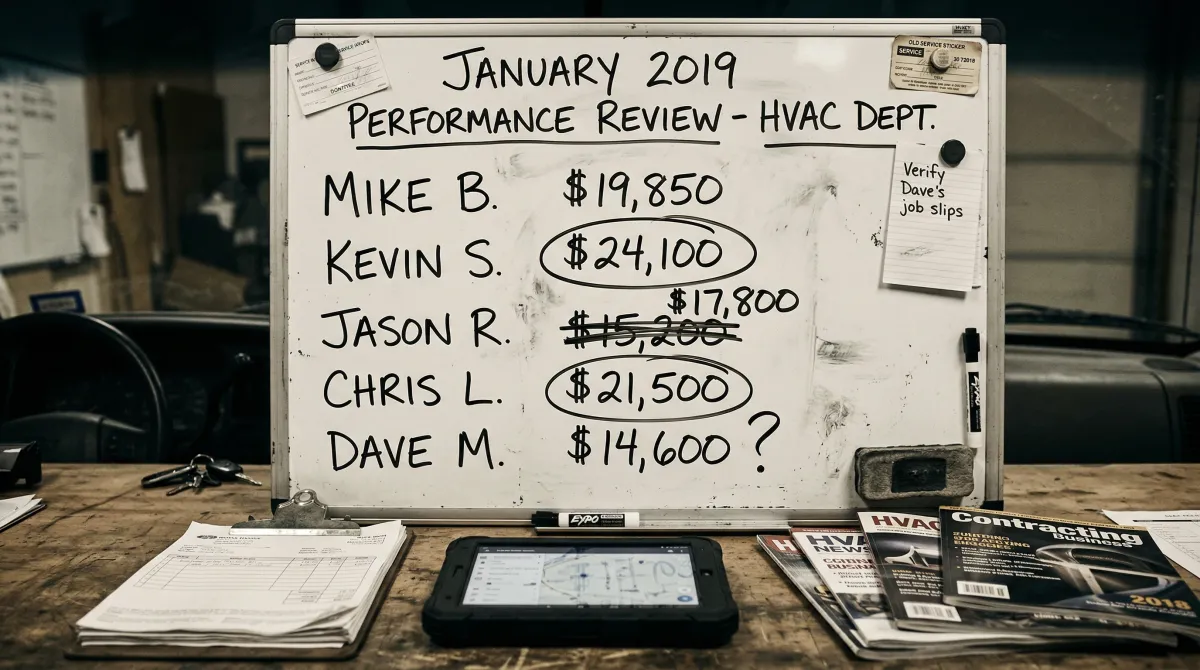
The spread. In most companies, the top-producing technician generates 2 to 3x the revenue of the bottom-producing one. They are working the same hours, running the same types of calls, in the same market. The output difference is not explained by luck or territory. It is explained by pricing, average ticket, and how they handle the estimate conversation on each call.
The pattern. When you break the individual numbers down further, revenue per job and jobs per day rather than just total revenue, the gap’s source usually becomes clear. High revenue with low job count means high average ticket. Low revenue with high job count means a pricing or job mix problem. Low revenue with low job count means dispatch, routing, or parts availability is throttling the tech’s capacity. Each pattern has a specific fix.
The Four Variables Behind Every Gap
Revenue per technician is produced by exactly four inputs. Improving any one of them moves the number. Understanding which one is driving your gap tells you where to focus.
Variable 1: Jobs Per Day (Utilization)
Three to five completed service and repair jobs per day is the top-performing range in HVAC. Fewer than three completed jobs per day consistently indicates a dispatch, routing, or parts availability problem, not a demand problem.
Dispatch efficiency is the operational lever behind this number.
Variable 2: Average Ticket
What does the average completed job invoice for?
This is the most directly controllable variable and the most underoptimized in most operations. Pricing inconsistency, different techs quoting the same job at different prices, is the most common cause of average ticket being lower than it should be. A tech who quotes a capacitor replacement at $240 and another who quotes $385 for the same job are not pricing based on different cost realities. They are pricing based on different confidence levels and different training.
Flat-rate pricing removes the variable. Good, better, best option presentation on replacement and installation work increases average ticket by presenting customers with a tier choice rather than a binary yes-or-no decision. Service agreement attachment at the end of service calls converts a one-time interaction into a recurring revenue relationship.
Variable 3: Job Mix
What percentage of calls are high-ticket versus low-ticket?
Job mix is the multiplier on everything else. A tech completing 4 jobs per day at $200 average generates $800 daily. The same tech completing 3 jobs per day at $1,200 average generates $3,600. Deliberately routing high-value calls to your best closing techs while routing tune-ups and inspections to newer techs during their ramp-up period is one of the highest-ROI dispatch decisions available.
In HVAC, the conversion from a service call to a system replacement recommendation, and whether that recommendation is made confidently and professionally, is often the single biggest driver of the revenue-per-tech spread between top and bottom performers.
Is Your Technician Productivity Stalling Your Growth?
Audit your current revenue per technician against the 2026 benchmarks for top-quartile trade operations to identify your productivity gap.
AUDIT YOUR PRODUCTIVITY →Variable 4: Revenue-to-Compensation Ratio
Is each technician generating enough revenue to justify their total cost?
The target in healthy home service operations is 14 to 20% of revenue going to technician wages. A tech earning $55,000 per year should be generating $275,000 to $390,000 in annual revenue. At $140,000 in annual revenue, that tech is costing 39 cents in wages per dollar of output, more than double the target.
This ratio, run by individual technician quarterly, shows which members of your team have compensation that has outpaced their productivity, and where coaching or job mix changes would bring the ratio back into range. It surfaces overpaying relative to output before the annual P&L shows it as a margin problem.
The Headcount Trap
The most common mistake in HVAC business scaling is treating a revenue gap as a headcount problem.
A company doing $1.8M with 8 technicians is producing $225,000 per tech. The owner wants to reach $2.5M. The instinct is to hire two more technicians.
If hiring those two technicians brings total revenue to $2.1M, because the new techs produce $150,000 each while the existing team’s per-tech output stays flat, the company went from 8 people producing $225,000 each to 10 people producing $210,000 each. Revenue grew but efficiency fell. Overhead went up. Margin compressed.
The alternative sequence: improve the four variables with the existing team first. What would revenue per tech look like at $250,000 company average instead of $225,000? With 8 existing technicians, that is $2M in revenue from the same headcount. With $270,000 average: $2.16M. With $290,000 average: $2.32M.
Adding headcount to a low-utilization, low-average-ticket operation adds the cost without adding the systems that would make the cost worth it.
It also breaks the gap down by variable, showing how much of the gap is likely explained by average ticket, job count, or headcount relative to revenue, so you know which of the four variables to work on first.
What to Do This Week
- Calculate your company revenue per technician. Last 12 months of invoiced revenue divided by field technician headcount. Write that number down.
- Calculate revenue per technician individually. Pull revenue by assigned tech for the last 90 days from your field service platform. Multiply each person’s 90-day number by 4 to get an annual run rate. Look at the spread between your highest and lowest producer.
- Identify the pattern. For each technician, find revenue per completed job and completed jobs per day. High jobs with low ticket is a pricing problem. Low jobs is a dispatch or utilization problem. Both low needs a direct conversation.
- Check your jobs-per-day average. Pull completed invoiced jobs per technician per working day for the last 30 days. If anyone is consistently below 3 completed jobs per day, find out why before assuming it is a demand problem.
Frequently Asked Questions
What is a good revenue per technician for HVAC?
Top-quartile HVAC companies generate $180,000 to $280,000 per technician annually. Industry average runs $150,000 to $180,000. Below $120,000 per technician indicates significant operational gaps, typically in pricing consistency, job mix, or utilization, that are worth diagnosing before adding headcount. Two HVAC companies with the same technician count in the same city routinely show 2 to 3x revenue per tech differences driven entirely by internal operations.
How do I calculate revenue per technician?
Divide total invoiced revenue for the last 12 months by your number of field technicians. For individual-level calculation, pull invoiced revenue attributed to each technician for the last 90 days, divide by working days in that period, and multiply by 250 for an annual run rate. Most field service platforms including ServiceTitan, Housecall Pro, and FieldEdge generate this report by technician natively.
Why is my revenue per technician low?
Four causes account for the majority of cases: low jobs per day (utilization or dispatch problem), low average ticket (pricing inconsistency or job mix skewed toward low-ticket work), high headcount relative to current demand, or high new-technician percentage where newer techs are producing below company average while ramping. The individual tech analysis, revenue per job and jobs per day rather than just total revenue, usually identifies which cause is primary within 20 minutes of pulling the data.
Is it better to improve revenue per tech or hire more technicians?
Improve revenue per tech first, unless your existing technicians are consistently running at 72%+ billable utilization and still declining or delaying calls due to genuine capacity constraints. Adding a technician to an operation where existing techs are below that utilization threshold adds cost without addressing the efficiency gap. When utilization is genuinely constrained and the operation is running well, a new technician enters a working system and can produce near the company average from month one.
What moves HVAC revenue per technician the fastest?
Three levers move it fastest: better dispatch utilization, higher average ticket through pricing discipline and option presentation, and a higher percentage of calls that convert into replacement or accessory work. Most companies do not need more technicians first. They need more output from the calls and labor hours they already have.
Built on Tenth is an independent HVAC market intelligence firm providing objective, data-backed diagnostic reporting for HVAC operators. We do not sell advertising, accept referral fees, or offer marketing agency retainers. Our loyalty is strictly to the data.