AUDITOR’S OVERVIEW
Cost per lead (CPL) is the primary dashboard metric for most HVAC marketing agencies. While we believe “cost per booked job” is the ultimate measure of success, understanding the market-level benchmark for lead costs across different digital channels is essential for setting realistic 2026 budgets. This article pulls current market data for core HVAC service categories to show what you should expect to pay for the initial phone call or form fill.
THE BOTTOM LINE
Not all leads are created equal. In 2026, a $120 Google LSA lead typically produces a lower “cost per booked job” than a $40 lead from a shared-lead platform because of the intent gap. Top-quartile HVAC operators don’t look for the cheapest leads—they look for the channels where the cost per lead most efficiently converts into an in-home dispatch.
This research dossier breaks down what every major HVAC lead channel costs in 2026: the cost per lead, the booking rate you can realistically expect from each, and the resulting cost per booked job.
Why Cost Per Lead Is the Wrong Number to Track Alone
Lead cost is the number most HVAC owners and agencies lead with. It’s easy to measure, easy to report, and completely insufficient as a decision metric.
Here’s why: a $50 lead that books at 25% costs you $200 per booked job. A $120 lead that books at 65% costs you $185 per booked job. The second lead is more expensive on paper and cheaper in practice.
The difference lives in lead intent — how ready the person is to schedule — and in your phone operation’s ability to convert the contact into an appointment. Those two variables, intent and booking rate, are what make the same dollar amount wildly different in actual cost.
The formula that matters:
Cost per booked job = Cost per lead / (Answer rate x Booking rate on answered calls)
At the industry average answer rate of 68% and booking rate of 42%, a $100 lead actually costs you $349 per booked job. That math is why so many HVAC companies feel like marketing isn’t working — the channel cost looks manageable, but the phone ops tax is invisible until you do the calculation.
The phone revenue calculator runs this for your actual numbers. Before evaluating any channel below, know your answer rate and booking rate. They change the output on every single source.
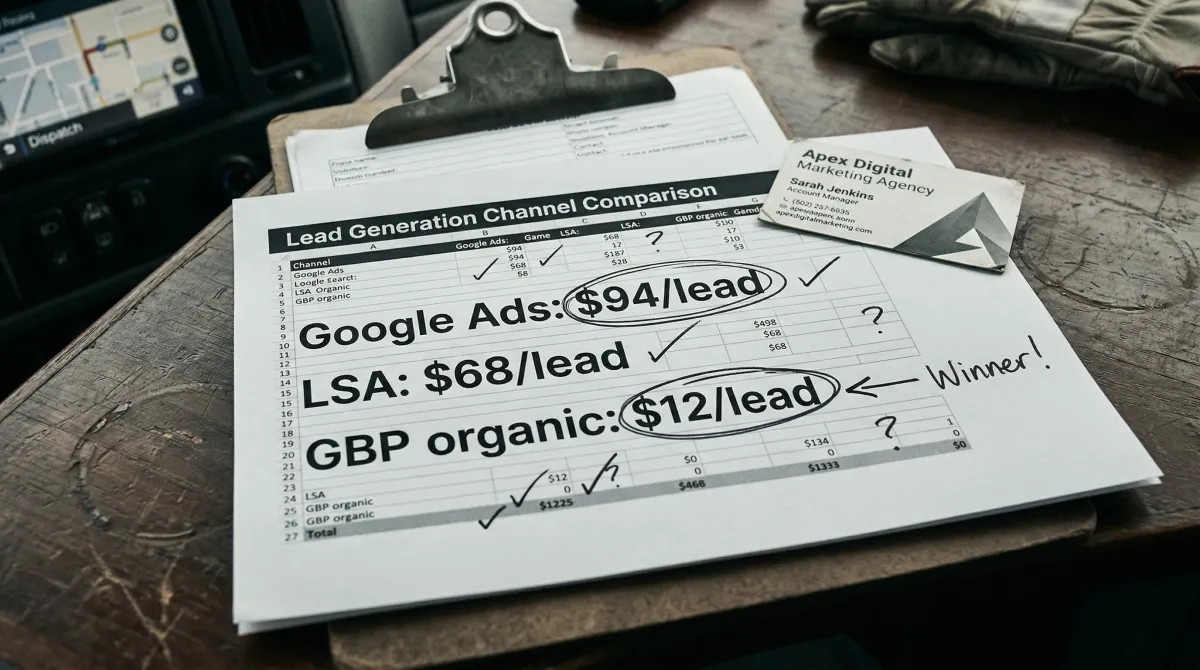
Lead cost gets clearer when channel math is separated on paper instead of blended into one monthly spend number.
Channel 1: Google Business Profile (Organic Map Pack)
Cost per lead: $0 to $25 (free traffic, time cost only) Booking rate: 65 to 80% (highest of any channel) Estimated cost per booked job: $5 to $25
GBP organic calls are the cheapest leads in HVAC. A homeowner searching “emergency HVAC near me” or “AC repair [city]” at 8pm who clicks the first map pack result and calls is one of the highest-converting contacts you’ll receive from any source. They’re local, they have an immediate problem, and they chose to call you specifically rather than clicking a paid ad.
Companies ranking in the top three map pack positions average 40% lower cost per sale than paid channels, according to data across hundreds of HVAC contractors. A properly optimized GBP generates 20 to 50 inbound leads per month for established companies in competitive markets — at effectively zero variable cost per lead.
The catch: GBP traffic isn’t purchased, it’s earned. Map pack position depends on review velocity, proximity, GBP activity (posts, photos, Q&A responses), and website signals. The time investment is real. The return, once position is established, is the best cost-per-booked-job number on the board.
What drives GBP ranking: 8 to 15 new reviews per month, owner response rate above 85%, one post per week minimum, and a mobile-fast website. The HVAC online presence teardown covers each of these signals in detail with dollar estimates attached to each gap.
Channel 2: Google Local Service Ads (LSAs)
Cost per lead: $25 to $75 (most markets) Booking rate: 50 to 65% Estimated cost per booked job: $55 to $185 (top performers)
LSAs sit above regular Google Ads in search results and charge per lead, not per click. Leads are exclusive phone calls and messages from homeowners who saw your Google Guaranteed badge and chose to contact you. Over 90% of LSA leads arrive as phone calls — the highest-intent format of any paid channel.
Based on a dataset of 100+ home service clients compiled in 2025, HVAC LSA leads typically cost $25 to $75 per lead depending on market competitiveness. At a 60% booking rate on answered calls, that produces booked jobs in the $55 to $185 range for top-performing operations. Companies with weaker phone ops see the number climb significantly — at 42% booking rate, a $60 LSA lead costs $285 per booked job.
LSA ranking isn’t controlled by bid alone. Review count, response rate, and dispute rate all affect how often your ad appears. About 6 to 7% of LSA spend typically comes back as lead credits for unqualified contacts. The setup process involves Google’s verification (license, insurance, background check) and takes two to four weeks — but it’s a one-time investment.
The full setup process, ranking mechanics, and the one setting most companies miss are covered in the HVAC LSA setup guide.
The real decision is never cost per lead alone. It is which channels survive contact with your booking process and still produce profitable jobs.
Channel 3: Google Ads — Non-Branded Search
Cost per lead: $144 to $198 (varies by campaign structure) Booking rate: 32 to 38% Estimated cost per booked job: $280 to $560
This is the most widely used HVAC paid channel and the one with the most variation based on campaign structure.
Based on SearchLight Digital’s January 2026 dataset tracking $14.9M in Google Ads spend across 816 HVAC-focused contractor campaigns, non-branded search campaigns average $149 per lead with a 37.6% book rate and a cost per paying customer of $804. General blended HVAC campaigns (not segmented by service line) average $198 per lead. Segmented heating repair campaigns average $144 per lead — a 27% difference from the blended approach.
That structure gap matters. A company running one blended “HVAC” campaign and a company running separate campaigns for emergency repair, installation, and maintenance are paying materially different costs per lead for identical keyword coverage. The Google Ads campaign structure article covers exactly what to change and the dollar difference it produces.
The booking rate gap between Google Ads and LSAs is significant: 37.6% vs. 50 to 65%. Search ads capture clicks, some of which aren’t ready to book. LSA callers are higher intent because they specifically chose to call through the verified listing. This is why the cost-per-booked-job comparison often favors LSAs despite the higher-looking CPL on Google Ads in some campaigns.
Where Google Ads wins: planned replacement keywords (“new HVAC system cost,” “heat pump installation”) and branded defense. These search intents don’t map cleanly to LSA triggers. Running both in parallel with separate budgets produces the best coverage.
Channel 4: Google Ads — Branded Search
Cost per lead: $34 Booking rate: 55% Estimated cost per booked job: $62
Branded campaigns — targeting your company name and common variations — are the most underused lever in HVAC Google Ads and produce the lowest cost per booked job of any paid channel.
The same SearchLight dataset shows branded HVAC campaigns average $34 per lead with a 55.3% book rate and a cost per paying customer of $104. That’s nearly five times cheaper per paying customer than non-branded search.
Most HVAC companies don’t run branded campaigns because they assume their organic listing captures those searches anyway. That assumption is often wrong — competitors actively bid on other companies’ brand names, and without a branded campaign, your organic listing may not be the top result when someone searches specifically for you.
At 5 to 10% of total Google Ads budget, branded campaigns protect revenue you’ve already paid to earn through every other channel. Skipping them is the equivalent of leaving the last mile of the race unrun.
Is Your CPL Inflated by Low-Intent Traffic?
Benchmark your lead costs by channel against the 2026 residential service averages to identify where you're overpaying for non-converting traffic.
AUDIT YOUR LEAD COSTS →Channel 5: Google Ads — Performance Max (PMax)
Cost per lead: $72 Booking rate: 32% Estimated cost per booked job: $225 to $340
Performance Max campaigns run across Search, Display, YouTube, Gmail, and Maps simultaneously using Google’s AI to control placement. The SearchLight data shows PMax delivers leads at $72 — 52% cheaper than non-branded search — but with a 32.2% book rate vs. 37.6% for non-branded search.
The net cost per booked appointment still favors PMax over a blended non-branded approach in most scenarios: $225 to $340 vs. $280 to $560 for non-branded. The trade-off is less visibility into what’s working — PMax limits the granular reporting available in standard search campaigns.
PMax works best as a supplement to segmented search campaigns, not a replacement for them. Companies generating fewer than 30 conversions per month don’t have enough data for Google’s algorithm to optimize effectively. Add PMax once your search campaigns are producing consistent conversion data.
Channel 6: Angi / HomeAdvisor (Pay-Per-Lead Aggregators)
Cost per lead: $45 to $120 (shared leads) Booking rate: 25 to 40% (heavily dependent on response speed) Estimated cost per booked job: $190 to $500+
Angi leads are shared — the same contact goes to up to three contractors simultaneously. The homeowner doesn’t know this. Your contact rate and booking rate are entirely determined by how fast you call and how many follow-up attempts you make. A company calling within five minutes contacts 70 to 80% of leads. A company calling two hours later contacts 20 to 30%.
At $130 average lead cost and a 35% booking rate on contacts made within five minutes, cost per booked job runs $190 to $230 for well-run operations. At a 25% contact rate and a 35% booking rate on contacts, that same $130 lead costs $1,486 per booked job. Same channel, same market, same lead price — the phone ops gap produces a 6x difference in actual cost.
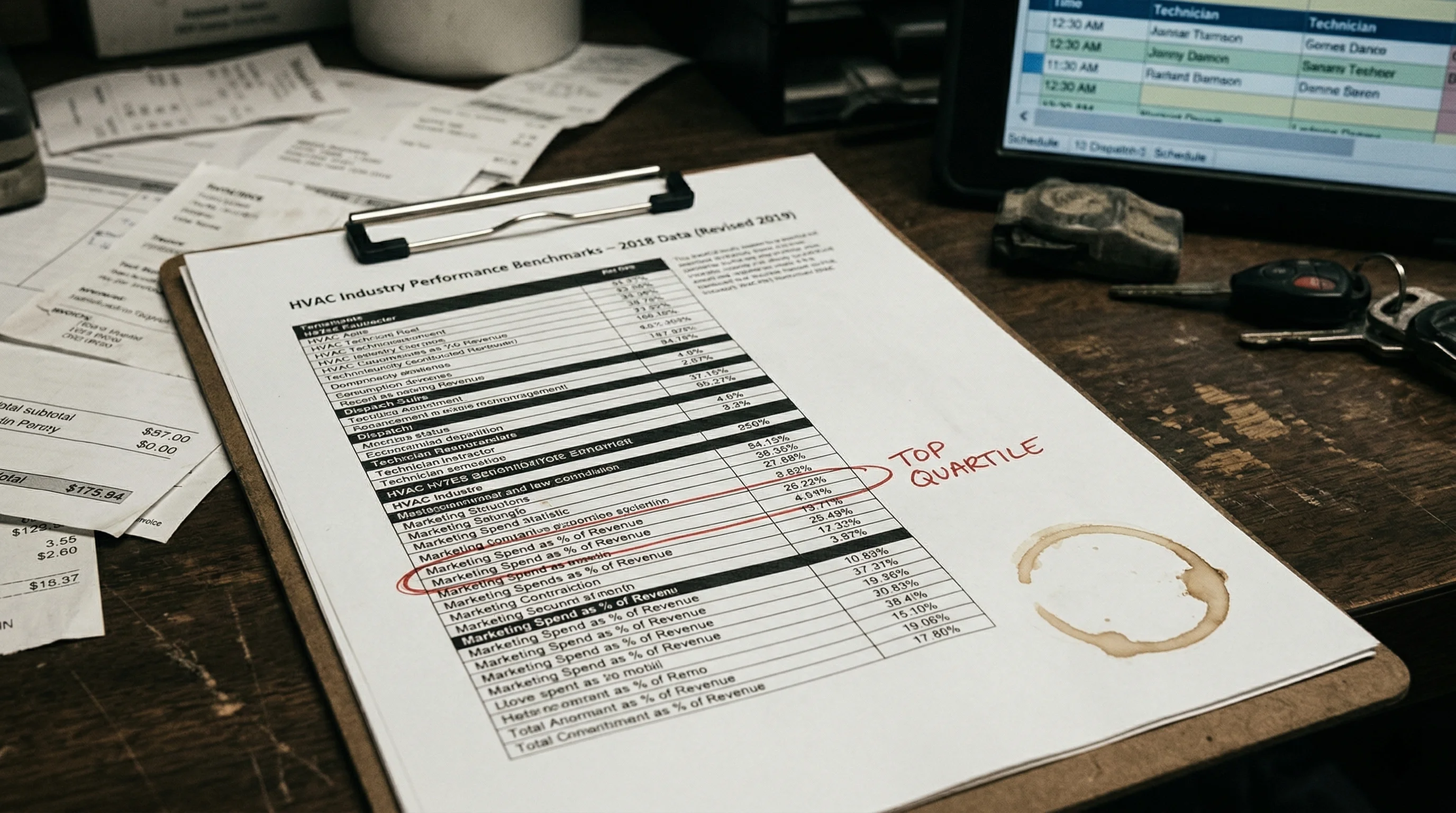
Most HVAC companies running Angi at marginal economics aren’t experiencing a channel problem. They’re experiencing a response-time and follow-up problem that makes every shared-lead channel look broken. The HVAC marketing benchmarks analysis shows that top-quartile companies spend 4 to 8% of their marketing budget on aggregators. Bottom-quartile companies spend 14 to 22%.
Channel 7: Facebook / Meta Ads
Cost per lead: $35 to $150 (varies heavily by offer type) Booking rate: 20 to 35% Estimated cost per booked job: $120 to $450+
Facebook leads are fundamentally different from every other channel in this list. A homeowner who finds you on Facebook was not actively searching for HVAC service. They were scrolling their feed and your ad interrupted them. That difference in intent has a direct impact on booking rate, urgency, and average ticket.
The most reliable Facebook lead data from HVAC-specific campaigns shows a $49 AC tune-up offer generating leads at $36 each with a 30% close rate — a cost per booked job of $120. That’s strong economics for a maintenance call. The same campaign economics applied to a $12,000 system replacement rarely work as well: installation-focused Facebook leads run $100 to $150 each with booking rates typically below 25%, producing cost per booked job north of $400.
Facebook works for HVAC in specific scenarios:
Where it produces positive ROI: Seasonal maintenance promotions (“$79 AC tune-up, book before June”), service agreement enrollment campaigns, retargeting website visitors who didn’t convert, and building awareness in a new service area before paid search kicks in.
Where it typically doesn’t: Emergency repair calls (those homeowners are on Google, not Facebook), high-ticket replacement campaigns as a cold-outreach channel, and any campaign without fast follow-up infrastructure. Responding to a Facebook lead within five minutes makes them 21 times more likely to convert, according to Meta’s internal data. Most HVAC companies aren’t set up to respond to social leads at that speed.
The budget range that works: $500 to $1,500/month for maintenance and seasonal promotion campaigns. Below $300/month, Facebook’s algorithm doesn’t have enough data to optimize. Above $5,000/month, you’re scaling a channel with lower intent than search — typically only appropriate once search channels are at capacity.
The Full Channel Comparison
| Channel | Avg CPL | Book Rate | Cost/Booked Job (Good ops) | Cost/Booked Job (Avg ops) |
|---|---|---|---|---|
| GBP / Organic Map Pack | $0-$25 | 70%+ | $5-$25 | $10-$40 |
| Referrals | $0-$30 | 75%+ | $0-$40 | $0-$50 |
| Branded Google Ads | $34 | 55% | $62 | $85 |
| Google LSAs | $25-$75 | 55-65% | $55-$185 | $140-$320 |
| Performance Max | $72 | 32% | $225-$340 | $280-$420 |
| Facebook (maintenance) | $35-$60 | 30% | $120-$200 | $180-$350 |
| Google Ads (segmented) | $144-$149 | 38% | $280-$380 | $380-$520 |
| Google Ads (blended) | $198 | 35% | $340-$450 | $450-$620 |
| Angi / aggregators | $45-$120 | 25-40% | $190-$400 | $380-$900+ |
| Facebook (replacement) | $100-$150 | 20-25% | $400-$600 | $550-$900+ |
“Good ops” assumes 88%+ answer rate and 60%+ booking rate on answered calls. “Avg ops” assumes 68% answer rate and 42% booking rate — the industry benchmarks from 300+ companies in the Built on Tenth dataset.
How Phone Ops Changes Every Number on This Table
Every cost per booked job figure above assumes the call gets answered and the CSR makes the booking ask effectively. When that doesn’t happen, every channel’s economics deteriorate by the same multiplier.
Here’s what the phone ops gap costs across channels at industry-average vs. top-quartile performance:
A company taking 300 calls/month at industry-average phone performance (68% answer rate, 42% booking rate) books 86 jobs. At top-quartile performance (90% answer rate, 62% booking rate), the same 300 calls produce 167 booked jobs — 94% more output from the same lead volume, same marketing spend.
Every channel comparison in this article assumes you’re answering calls and booking appointments at a competitive rate. If you’re not, the real cost per booked job on every channel above is significantly higher than shown.
The CSR performance breakdown quantifies what specific gaps in answer rate and booking rate cost per year in actual dollars. Run those numbers before deciding any channel is too expensive.
How to Use This Data to Reallocate Budget
The table above isn’t a ranking of which channels are good or bad. It’s a map of where cost per booked job is lowest and where it’s highest — and that map should drive budget decisions.
The reallocation logic:
If your GBP isn’t optimized and you’re not in the top three map pack positions, that’s the highest-ROI fix available. Not more ad spend — a GBP and review system investment that produces the cheapest leads on the board.
If you’re running Google Ads but not LSAs, you’re paying for clicks that sit below the section capturing the highest-intent searchers. Adding LSAs at 25 to 30% of your paid budget typically reduces blended cost per booked job materially.
If you’re running blended Google Ads campaigns rather than segmented by service line, restructuring produces the same leads for 15 to 27% less spend. That’s money you can redirect or keep.
Facebook belongs in your mix only if you have a specific maintenance promotion or seasonal offer, dedicated follow-up for social leads within five minutes, and budget left after search channels are adequately funded.
Use the marketing cost calculator to benchmark your current blended cost per booked job against these channel-level figures. The gap between what you’re currently paying and the top-quartile benchmarks above is the dollar amount better allocation is worth.
What to Do This Week
- Calculate your cost per booked job by channel. Total spend on each source last month divided by booked jobs traced to that source. Even a rough estimate by channel is more useful than a blended number.
- Check your GBP position. Search your primary keyword from an incognito window. If you’re not in the top three, you’re paying for paid channels to capture traffic that should cost you nothing.
- If you’re running Google Ads, ask your agency for CPL by campaign type. Branded vs. non-branded vs. PMax separately. If they can’t provide it, your account is structured as a blended campaign and the $198 average CPL benchmark likely applies.
- Check your answer rate and booking rate. Pull the last 30 days from call tracking. Calculate what your current phone performance is doing to every channel’s economics using the formula above.
- Use the marketing cost calculator to model what your cost per booked job looks like at your current phone performance vs. top-quartile phone performance across each channel you’re running.
Frequently Asked Questions
What is the average cost per lead for HVAC companies?
The blended average across all Google Ads campaign types is $104, based on SearchLight Digital’s January 2026 dataset of $14.9M in spend across 816 contractors. That blended figure includes branded search at $34, non-branded search at $149, and Performance Max at $72. GBP organic leads cost effectively zero per lead. LSA leads run $25 to $75. Angi leads run $45 to $120. Facebook leads run $35 to $150 depending on the offer type.
Which HVAC lead channel has the lowest cost per booked job?
Google Business Profile organic leads produce the lowest cost per booked job of any channel — typically $5 to $25 — because the traffic is free and the intent is extremely high. Referrals are comparable. Among paid channels, branded Google Ads produce the lowest cost per paying customer at around $62, followed by LSAs at $55 to $185 for operations with strong phone performance.
Are Angi leads worth it for HVAC?
At industry-average phone performance, rarely. The combination of shared leads, variable lead quality, and the speed-to-call requirement makes Angi economics work only for companies that call within five minutes and run a three-touch follow-up sequence. Top-performing HVAC companies allocate 4 to 8% of their marketing budget to aggregators. Companies spending 14 to 22% on Angi are almost always overpaying relative to what the channel produces.
How do Facebook ads compare to Google Ads for HVAC?
Fundamentally different intent, fundamentally different economics. Google captures homeowners actively searching for HVAC service. Facebook interrupts homeowners who aren’t looking. Facebook works for lower-ticket maintenance promotions at $35 to $60 per lead with a 30% booking rate. It rarely produces positive ROI on high-ticket replacement campaigns as cold-outreach. Google search and LSAs consistently outperform Facebook on cost per booked job for emergency and replacement work.
How does phone performance affect cost per lead?
CPL itself isn’t affected by phone performance. Cost per booked job is. At 68% answer rate and 42% booking rate (industry averages), a $100 lead costs $349 per booked job. At 90% answer rate and 62% booking rate (top quartile), the same $100 lead costs $180 per booked job. Phone performance is a multiplier that applies to every channel simultaneously. Improving it is often worth more than switching channels.
Should HVAC companies run LSAs and Google Ads at the same time?
Yes. They appear in different positions on the results page and capture different search intents. LSAs capture the highest-intent callers at the top of the page with a Google Guaranteed badge. Google Ads capture specific service and replacement keywords that don’t always trigger LSA placements. Running both with separate budgets typically produces better total coverage and lower blended cost per booked job than either channel alone. The recommended split at $1M to $3M revenue is LSAs at 30 to 40% of paid budget and Google Ads at 25 to 30%.
What is Performance Max and is it worth running for HVAC?
Performance Max (PMax) is a Google campaign type that runs across all Google channels simultaneously using AI to control placement. It produces leads at $72 — 52% cheaper than non-branded search — but with a lower booking rate (32.2% vs. 37.6%). Net cost per booked appointment still favors PMax over blended non-branded search in most cases. Best used as a supplement to segmented search campaigns once your account is generating 40+ conversions per month and has strong conversion tracking in place.
Built on Tenth is an independent HVAC market intelligence firm providing objective, data-backed diagnostic reporting for HVAC operators. We do not sell advertising, accept referral fees, or offer marketing agency retainers. Our loyalty is strictly to the data.